


Last Updated: 6 November 2026
Quick Summary
A kindness challenge is a short, specific plan with one small action each day, which turns good intentions into a household habit. For mums, the best ideas are small enough for an ordinary day, and they work for children as well as adults. A 30-day plan gives the family a clear start and finish.
- Choose one small action per day, so the challenge feels manageable on an ordinary day.
- Involve the children in picking actions, since children remember what they practise.
- Rotate ideas weekly and note which ones your family asked to repeat.
- Include acts that reduce mental load, such as taking one recurring task off her list.
- Keep the first week gentle and expect a few missed days, since the aim is a habit.
Table of Contents
- Why a Kindness Challenge Works for Mums and Families
- Kindness Challenge Ideas for Mothers at Home
- Building a 30-Day Kindness Challenge
- Kindness Challenge Ideas for Mothers PDF: Printables and Planners
- Kindness Challenge for Adults: Looking After Yourself Too
- Adapting Ideas by Age, Ability and Family Situation
- Starting Your Kindness Challenge This Week
- Frequently Asked Questions
Why a Kindness Challenge Works for Mums and Families
Kindness challenges work because they turn a good intention into a daily habit. A short, specific challenge with one small action each day is a simple way to keep kindness going at home.

A kindness challenge also gives the whole family a shared focus. Mums often carry the mental load of the household, so a plan that everyone can join, including the children, takes some of that pressure off.
Kindness Challenge Ideas for Mothers at Home
The best ideas are small enough to do on an ordinary Tuesday. They work because they feel personal rather than performed. Start with what your household already does well and add one new action at a time.
Pick a few ideas that fit your routine, then rotate them each week so nothing becomes a chore. Keep a note of what worked, because the ideas that landed best are usually the ones your family asked to repeat.
Small Acts Children Can Do for Their Mum
Children can do more than they think. A handwritten note on the kitchen worktop, a drawing taped to the fridge, or a cup of tea delivered with a spoon balanced on the saucer all make a mum feel noticed.
A kind word is often the most valuable gift. Ask your child to say one thing they appreciate about you each day. It sounds simple, and it usually lands harder than expected.
Low-Cost and No-Cost Ideas
Many of the most meaningful acts cost nothing. A ten-minute walk together, a family dance party in the living room, or a tickle session before bed all build connection. You can also share a sweet note in a lunchbox or leave a message on the bathroom mirror.
If you do want a small treat, keep it simple. A piece of homemade shortbread or a single flower from the garden tends to mean more than an expensive purchase.
Building a 30-Day Kindness Challenge
A 30-day plan gives your family a clear start and finish. As the weekly themes build small acts of care into a habit, they can also support teaching resilience to kids by helping children practise kindness when things feel difficult.
Our 30-day kindness challenge is set out as a printable calendar, so you can tick off each day and see the streak grow.
30-Day Kindness Challenge [PRINTABLE] →

Kindness Challenge Ideas for Mothers PDF: Printables and Planners
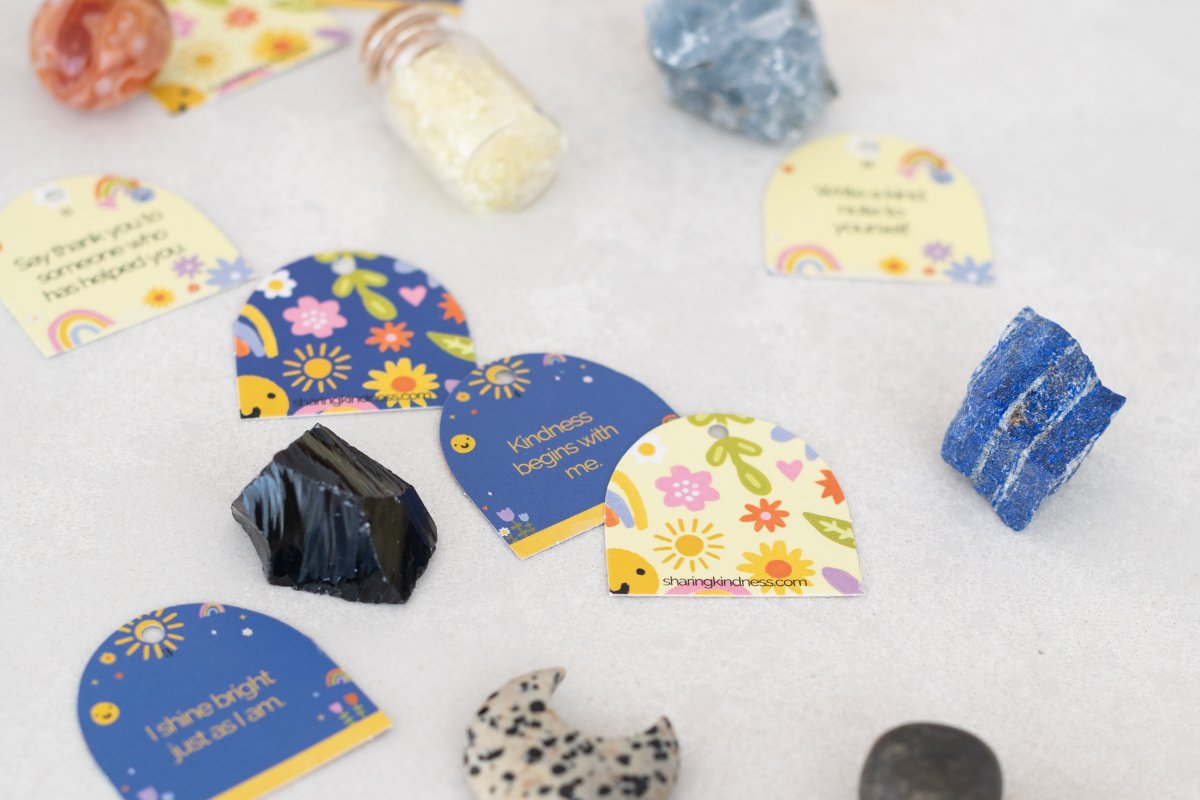
If you prefer something ready to use, printables save time. The Mother's Day Kindness Kit is a printable kit with hand-drawn illustrations, acts of kindness and love coupons, and it includes a selection of affirmation cards.

For a more flexible list, the Kindness Bucket List Kit gives you a range of ideas to tick off over time, and it can be framed or laminated.

Kindness Challenge for Adults: Looking After Yourself Too
Most kindness challenges aimed at mothers focus on what children can do for her. That misses half the picture. A mother who is running on empty has little left to give, and a challenge that only adds tasks to her list can become another chore. The adults in the house need kindness too, and that includes you.
Kindness that reduces mental load
Mental load is the invisible work of remembering, planning and reminding. It is often heavier than the visible tasks. Kindness acts that reduce it are worth more than a bunch of flowers. Try these:
- Take one recurring task off her list entirely for a week, such as school forms, meal planning or appointment booking.
- Set up a shared calendar or a family whiteboard so she is not the only one holding the schedule.
- Handle a decision she would normally make, such as what is for dinner, without asking her what she wants.
Watch out: do not announce that you are 'helping' and then ask her where everything is. That adds to the load rather than reducing it. Learn the routine first.
Kindness that supports rest and wellbeing
Rest is not a reward for finishing everything else. It is part of staying well. Small, repeatable acts work better than occasional grand gestures:
- Protect a thirty-minute window each day where no one asks her for anything.
- Make her a hot drink and take the children to another room while she drinks it.
- Put fresh bedding on her bed without being asked.
- Run her a bath and handle bedtime for the children.
Kindness towards yourself
If you are the mother in the challenge, you are allowed to be on the receiving end. Pick one act of kindness towards yourself each day and treat it as part of the challenge rather than an indulgence. Examples that fit a crowded day:
- Ten minutes with a cup of tea and no screen.
- Saying no to one request that you would normally say yes to out of guilt.
- Going to bed thirty minutes earlier.
- Asking for help with one specific task instead of managing alone.
A common pattern is that mothers find it easier to plan kindness for everyone else than to accept it themselves. If that sounds familiar, start with the smallest possible act and let it count.
For more practical routines that fit a busy schedule, our guide to non spiritual self care for busy mums covers ideas you can use alongside the challenge. You might also enjoy positive mindset games for mums to play at home, which are easy to fit in after the children are in bed.
Adapting Ideas by Age, Ability and Family Situation
A kindness challenge works best when the actions fit the child doing them. A three-year-old cannot plan a surprise outing, and a teenager may find a sticker chart patronising. Use the bands below as a starting point, then adjust for your own child's temperament and abilities.
Toddlers and preschoolers (ages 2 to 4)
Keep it physical, immediate and led by you. At this age kindness is learned through copying, so narrate what you are doing. Try these:
- Helping put a cushion back on the sofa.
- Carrying a nappy or a book to a sibling.
- Giving a hug or a high five when someone looks sad.
- Dropping a biscuit into a bowl for a pet.
Watch out: toddlers will often want to keep the flower or eat the biscuit themselves. That is normal development, not a failure of the challenge. Praise the attempt and move on.
30-Day Kindness Challenge [PRINTABLE] →
Primary-age children (ages 5 to 11)
This is the sweet spot for a challenge because children can plan, write and carry out tasks with light supervision. Ideas that work well:
- Writing a note or drawing a picture for Mum and hiding it under her pillow.
- Making her a cup of tea with help from an adult.
- Taking over one chore for the day, such as setting the table or feeding the pet.
- Choosing a book to read together at bedtime.
Teenagers (ages 12 and up)
Teenagers often prefer kindness that feels autonomous and not babyish. Offer options rather than instructions:
- Cooking a simple meal or baking something for the family.
- Taking younger siblings out for an hour so Mum can rest.
- Writing a longer letter or a list of things they appreciate.
- Researching a local cause and suggesting a small family donation or volunteer slot.
Children with additional needs or disabilities
Adapt the action to the child's strengths rather than the other way around. A child who uses a wheelchair might plan a kindness act rather than carry it out physically. A child who is non-speaking might choose a picture card to give. A child who finds change difficult might prefer the same kindness act repeated daily rather than a new one each day.
Different family structures and circumstances
Not every family has a mother at home, and not every mother wants the same things. Adapt the challenge to your situation:
- Stepmums and foster or adoptive mothers: Let the child decide what feels comfortable. A kind word or a shared activity may land better than a gift.
- Single-parent families: Keep the challenge small and low-effort. One act a day is plenty, and the parent can also be the recipient.
- Bereaved families: A kindness challenge can be a gentle way to remember someone. Consider acts done in memory, such as donating to a cause they cared about.
- Families living far apart: Send a card, a voice note or a photo of a completed kindness act. Distance does not rule out connection.
A common pattern is that the families who get the most from a challenge are the ones who ask the mother what she would genuinely find helpful, rather than assuming.
The right kindness act depends on the child doing it, so the article groups ideas by age and circumstance.
| Age or situation | Example act | Note |
|---|---|---|
| Toddlers (2 to 4) | Carrying a nappy or a book to a sibling | Keep it physical and led by an adult |
| Primary age (5 to 11) | Writing a note and hiding it under Mum's pillow | Can plan and carry out with light supervision |
| Teenagers (12 and up) | Taking younger siblings out for an hour | Offer options rather than instructions |
| Additional needs | Picture card to give instead of speaking | Adapt to the child's strengths |
| Bereaved families | Donating to a cause the person cared about | Consider acts done in memory |
| Families living far apart | Sending a card, voice note or photo | Distance does not rule out connection |
Starting Your Kindness Challenge This Week
Choose your first action today and write it on a sticky note. Involve the children in picking the rest, and decide together how you will mark each day.
At Sharing Kindness, our products are designed to help families start these conversations, from the Kindness Crystals Pass-It-On Stone Set to the Kindness Pin Badges. Pick one, add it to your challenge, and see what changes for your family.
Frequently Asked Questions
What are some ideas for a kindness challenge?
A good kindness challenge mixes small daily actions with a few bigger ones. Ideas include leaving a sticky note with a kind message, doing a household task without being asked, making a cup of tea for someone, or sending a thank-you text to a friend. For a mum, the most useful ideas are the ones that take her load off for an hour, such as taking over bath time or tidying the kitchen. Keep each act to five minutes or less so it fits into an ordinary day.
How can a mum start a 30-day kindness challenge?
Start by choosing a simple calendar, either a printed page on the fridge or a printable 30-day kindness challenge. Write one act per day, then leave a few days empty so the plan can flex around illness, busy weeks or days when nothing goes to plan. Talk through the challenge with your children so they can suggest ideas and tick off completed days together. Check in at the end of the week to note what felt good and what to keep.
Can you do a kindness challenge on your own?
Yes. A solo challenge works well because you control the timing and the choices. Many mothers find that including self-kindness helps, such as taking a ten-minute walk, saying no to one extra task, or writing down one thing they did well each day. Keeping a short reflection journal makes the challenge visible and helps you notice patterns in how kindness affects your mood and your relationships.
What are 20 ways to show kindness to your mum?
Try writing her a note listing three things you appreciate about her, cooking her breakfast, drawing her a picture, giving her a hug without being asked, or offering to read her favourite book aloud. Other ideas include doing one of her chores, making her a cup of tea and bringing it to her, setting the table, putting a small treat by her bed, or dancing together in the kitchen. Most of these cost nothing and work best when they are specific and sincere.
