


Last Updated: 29 October 2026
Quick Summary
Positive mindset games are short, repeatable activities that fit into ordinary family moments, such as breakfast, the school run or bedtime. They help mums build consistent wellbeing habits, with the aim being consistency rather than perfection. Most practices take five minutes or less.
- Most mindfulness practices in the guide take under two minutes each.
- Attach a daily practice to an existing anchor, such as the morning kettle, and keep it on that anchor for a week.
- Name one specific good moment each evening, taking under a minute.
- The Sharing Kindness Game includes three levels of question prompts and a 21-day tracker.
- Add one self-kindness act to a family kindness challenge each week during busy seasons.
Table of Contents
- Why Mums Need Positive Mindset Games (and Why Five Minutes Is Enough)
- Mindfulness Activities for Mums You Can Fit Into Ordinary Days
- Daily Gratitude Exercises for Parents That Stick
- Positive Mindset Games to Play With Your Kids
- Self-Kindness Games for Mums Who Feel Like They're Failing
- Kindness Challenges for Families During a Busy Season
- Choosing a Starter Game for Your Household This Week
- Frequently Asked Questions
Why Mums Need Positive Mindset Games (and Why Five Minutes Is Enough)
Most mums already know they should make time for their own wellbeing. The problem is finding the time at all. Sharing Kindness built its family games and affirmation cards around exactly this gap, because a practice that needs an hour rarely survives a school week. Positive mindset games work because they are short, repeatable and built into ordinary moments like breakfast, the drive home or bedtime.
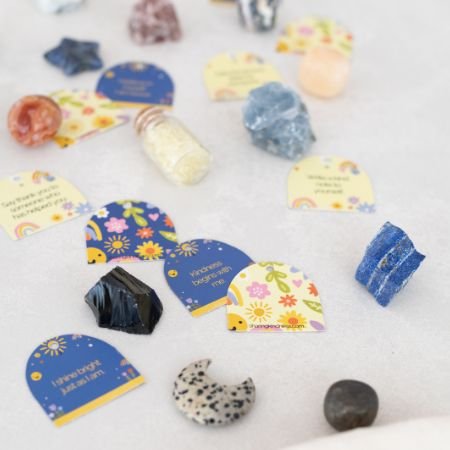
A five-minute game asks very little of you. Research on gratitude and reflective practice generally suggests that small, regular habits do more than occasional long sessions, although the strength of that evidence varies between studies positive psychology research on gratitude practices. For a closer look at whether affirmation cards earn a place in your routine, read whether self-compassion affirmation cards are worth using daily.
Here is what you can expect from this guide:
- Quick mindfulness activities that fit into ordinary days
- Gratitude exercises you can keep doing past the first week
- Games to play with your children, including a stone-based ritual
- Self-kindness practices for the days you feel you are failing
- Seasonal kindness challenges for busy periods
- A simple way to choose one starter game for your household
Mindfulness Activities for Mums You Can Fit Into Ordinary Days
Mindfulness does not require a cushion or a quiet house. It means noticing what is in front of you for a moment, and most mums can do that while the kettle boils or the car warms up. The five-minute constraint is the point: a practice you can attach to something you already do is far more likely to survive a school week than one that needs a cleared diary.
Try these short practices, each under two minutes:
- Three breaths at the sink. Before you turn the tap on, take three slow breaths and notice the temperature of the water.
- One sound, one colour. Pick one thing you can hear and one thing you can see, and name them silently.
- Mindful transitions. Pause for a breath before you walk into a new room or start a new task.
- The five-minute reset. Set a timer for five minutes, sit down, and do nothing except notice your feet on the floor and your back against the chair. When the timer goes, carry on. The constraint is what makes it doable.
- The one-thing rule. Choose a single ordinary task each day (washing up, folding laundry, walking to the school gate) and do only that task, without your phone or a podcast. Most mums find the first two minutes restless and the last three surprisingly steady.
Mindfulness activities for mums work best when they are attached to something you already do. Choose one anchor moment each day and keep the practice small enough that you will not skip it. Establishing these consistent anchors creates a stable foundation for introducing screen-free activities that encourage your children to join in with your newfound sense of calm.
For mums who find silent practices difficult, a guided alternative can help. The Box of Confidence affirmation cards are a practical way to bring short prompts into a conversation with a child. The aim is consistency, not a perfect streak.
Daily Gratitude Exercises for Parents That Stick
Gratitude exercises fail when they become another chore. The version that tends to last is the one that takes less than a minute and asks for one specific thing.
Each evening, name one moment from the day that made you feel something good. Be specific: "the toast was warm" is more useful than "I'm grateful for food". Writing it down in a notebook helps, but speaking it aloud to a partner or child works just as well.
Physical reminders can also help. A smooth stone or a printed card on the kitchen worktop can prompt the habit. Sharing Kindness sells printable gratitude and affirmation posters if you would rather hang something on the wall.
The article sets out a few practical ways to build gratitude into a day, so here is a quick reference.
| Practice | When to do it | Key point |
|---|---|---|
| Name one good moment | Each evening | Be specific, under a minute |
| Write or say it aloud | Each evening | Notebook or a partner or child |
| Gratitude stone | Bedtime or evening | Pass it round the table |
| Printed card or poster | Kitchen worktop or wall | Physical reminder to keep the habit |
Positive Mindset Games to Play With Your Kids
Children learn to see the world more positively when the lesson feels like play rather than instruction. For a fuller guide to making kindness fun for young minds, see the kindness advent guide. Games that invite stories, feelings and small acts of kindness tend to hold attention longer than lectures.
The Sharing Kindness Game is a family card game built around sharing stories of gratitude, fears and feelings. It has three levels of question prompts, with action cards mixed in to keep things light.
For younger children, the Box of Confidence affirmation cards offer 40 hand-drawn cards with four characters children can relate to. If you want a digital option, the Printable Affirmation Cards are available for 12.95.
Using a Gratitude Stone as a Daily Ritual
A gratitude stone turns an abstract idea into something children can hold. Our guide explains how to use pass-it-on kindness stones with children step by step. Each evening, pass the stone around the table and let the person holding it name one thing they were grateful for that day. Children often find this easier than answering "how was your day?"
The Gratitude Rock is a smooth stone you can keep in a pocket or on the bedside table, and let it become part of the bedtime routine.
Self-Kindness Games for Mums Who Feel Like They're Failing
Many mums are harder on themselves than they would ever be on a friend. Self-kindness games give you a way to interrupt that pattern without turning it into a big emotional project.

Try this simple game when a hard day has gone sideways. Name the thing that went wrong, then write one sentence you would say to a friend in the same situation. Read it back to yourself.
Another option is a "good enough" tally. At the end of the week, list three things you handled reasonably well, even if they were small. Dinner happened. A school form got signed. You called someone back.
If you are struggling beyond the everyday, speak to your GP or a qualified professional (Mental Health Hub | Health and Wellbeing). Games can support wellbeing, but they are not a substitute for care.
Kindness Challenges for Families During a Busy Season
December and other busy seasons tend to crowd out the things that matter most. A short kindness challenge can bring the family back to what you care about without adding pressure.
Choose one small act per day for a set period. Keep the acts simple and free: drawing a picture for a neighbour, leaving a note of thanks for the bin collector, or letting a sibling choose the bedtime story. The Kindness Advent Calendar is a ready-made option for the countdown to Christmas.
Ask each child what they would like to try, then let them choose. Children who pick the challenge themselves are far more likely to follow through, and you will avoid the eye-rolling that comes with something imposed from above.
Five-minute kindness acts that fit a school night
- The two-minute note. Write one sentence of thanks on a sticky note and leave it on a lunchbox or a bathroom mirror.
- The car-park compliment. On the school run, name one thing you appreciated about the day out loud before the engine turns off.
- The digital kindness message. Send one short voice note or text to a friend who is also in a busy season. It takes under a minute and costs nothing.
- The bin-collector thank-you. Tape a note to the bin lid the night before collection. Children remember this one because they see the result.
Self-kindness acts for the adult in the room
A kindness challenge that only points outward tends to run out of steam by mid-December. Add one self-kindness act to the calendar each week:
- The good-enough tally. At the end of the day, list three things you handled reasonably well, even if they were small.
- The friend sentence. When something goes wrong, write the sentence you would say to a friend in the same situation and read it back to yourself.
- The five-minute pause. Put a five-minute timer on and do nothing except sit down. This counts as a kindness act, not a reward you have to earn.
If you want a ready-made structure, the Sharing Kindness Game includes a 21-day tracker, with action cards mixed in to keep the tone light. For families who prefer a printable option, the Printable Affirmation Cards are available as a digital download.
Choosing a Starter Game for Your Household This Week
If you are unsure where to begin, pick one option and try it for seven days. Keep the choice practical:
- Short on time, kids are young: Start with a gratitude stone at bedtime.
- Kids are older and talk less: Try the Sharing Kindness Game for a few questions each evening.
- Want something for yourself: Begin with three breaths at the sink and one self-kindness sentence at night.
- Busy season is coming: Start a kindness challenge with one act per day.
After a week, ask yourself which practice felt easiest to keep. Build from there rather than adding everything at once.
Frequently Asked Questions
How can I improve my mindset as a busy mum?
Start with one small, repeatable habit rather than a full overhaul. A two-minute gratitude note each night, or saying one kind sentence to yourself while the kettle boils, works better than a long routine you will abandon by Thursday. Pick the moment that already happens every day, such as school pick-up or bedtime, and attach the habit to it. Consistency matters more than length, and you can add more once the first habit feels automatic.
What are some simple mental health games for parents?
Simple options include a gratitude round at dinner where everyone names one good thing from their day, or a card game built around sharing stories and feelings. The Sharing Kindness Game ($59.95) includes 120 question cards across three levels, plus a gratitude moon rock, a 21-day tracker and journaling prompts. Choose something you can play in ten minutes or less so it fits into a tired weeknight.
How do you practise positive thinking when feeling overwhelmed?
When you feel overwhelmed, shrink the focus. Name one thing you can control in the next ten minutes and do only that. Keep a gratitude stone or affirmation card within reach, and when you pick it up, notice one specific thing that is going reasonably well, even if it is small. This does not erase hard feelings, but it gives your mind a short, concrete place to rest rather than a list of everything that is wrong.
How can I teach my children kindness while working on my own mindset?
Do the exercises alongside them rather than assigning them. When children see you admit a hard moment and name something you are grateful for, they learn that feelings are normal and that adults practise these skills too. The Box of Confidence affirmation cards, designed for children aged 4-12, can help start these conversations.
Start small with the Sharing Kindness Game, a gratitude stone or a printable poster, and see what your family enjoys. Get started with Sharing Kindness and build a routine that suits your household.
