


Last Updated: November 5, 2026
Quick Summary
Confidence gifts give anxious kids a small, portable reminder that they are capable, loved and safe when the classroom feels overwhelming. Choose a quiet, pocket-sized item such as a worry stone, affirmation cards or a small fidget tool, and check school policy before you buy. Introduce the gift before the anxiety peaks so it works as a tool for emotional regulation.
- Keep a school calm-down kit to five or six quiet pieces that fit in a pencil case.
- Avoid items that make noise, light up or look like toys, as teachers may send them home.
- Praise effort and bravery rather than outcomes, naming the small brave moments you notice.
- Children aged four to twelve can use the Box of Confidence, which has 40 affirmation cards.
- Confirm the school's rules again in the first week of September, as policies often tighten.
Table of Contents
- Why Confidence Gifts Help Anxious Kids at Back to School
- Calm Down Kit Ideas for School
- Back to School Anxiety Tips for Parents
- Positive Reinforcement Ideas for Anxious Kids
- Confidence Gifts That Suit Different Ages
- Checking School Policy Before You Buy
- Choosing Your Confidence Gift from Sharing Kindness
- Frequently Asked Questions
Why Confidence Gifts Help Anxious Kids at Back to School
Back to school confidence gifts for anxious kids work because they give a child something tangible to hold onto when the classroom feels overwhelming. A small object or card set becomes a portable reminder that they are capable, loved and safe.
The first day jitters are normal (the NHS). What matters is what you hand your child alongside the school bag. A confidence gift is not a bribe or a distraction. For a broader roundup of confidence gifts for children starting school, see our full guide. It is a tool for emotional regulation, and it works best when you introduce it before the anxiety peaks.
Here is what we cover: how to build a calm-down kit, practical anxiety tips for parents, positive reinforcement ideas, age-specific gift choices and how to check school policy before you buy. We will also show you exactly which options suit which child.
Calm Down Kit Ideas for School
Calm down kit ideas for school should be small, quiet and easy for a child to use without drawing attention. The best kits fit inside a pencil case or a small pouch and contain items that support sensory regulation and grounding techniques.
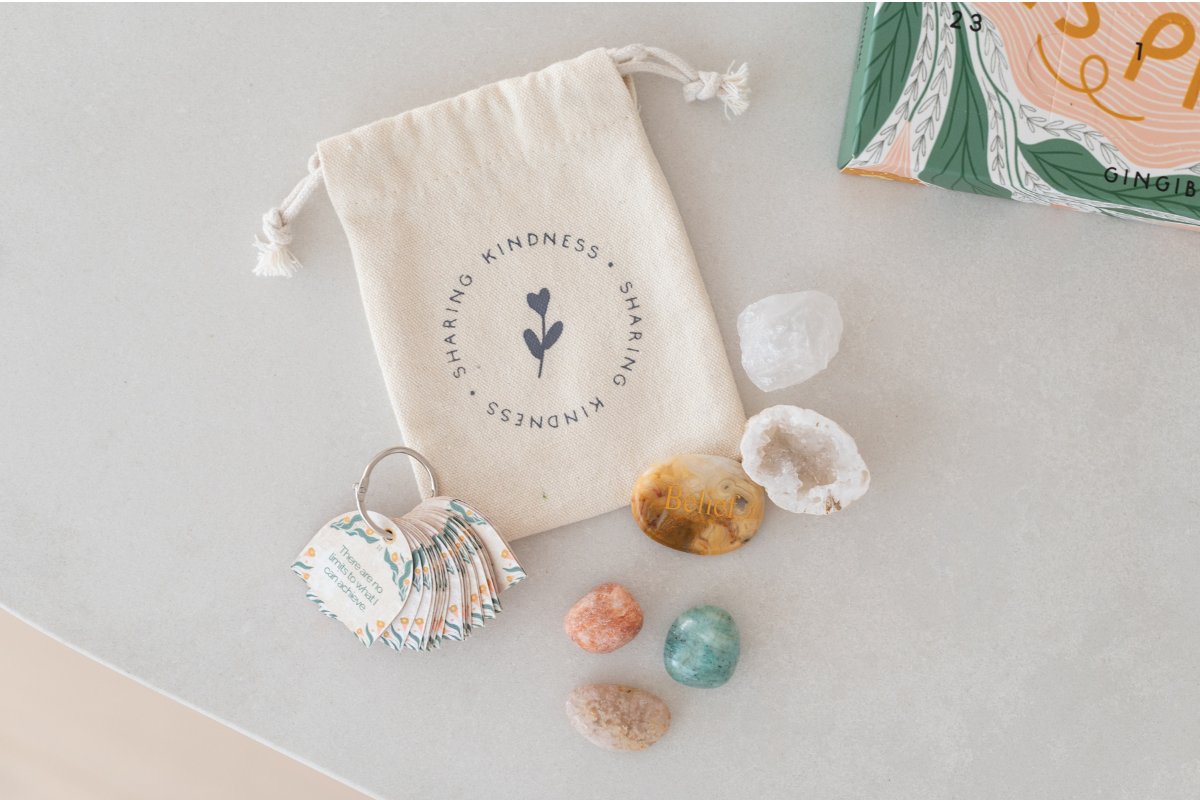
What to Put in a School Calm-Down Kit
A school calm-down kit is a small collection of comfort items a child can reach for when feelings build up. Keep it to five or six pieces so it stays manageable.
- A smooth worry stone for tactile stimulation and grounding
- Three or four affirmation cards with simple, positive self-talk
- A small fidget tool that does not make noise
- A folded card with a breathing prompt for deep breathing
- A photo of family or a pet for emotional support
- A soft, small comfort item that fits in a pocket
Watch out: avoid anything that makes noise, lights up or looks like a toy. Teachers will ask for it to go home, and your child loses the tool that was helping.
If you want the affirmation cards to form the centrepiece of the kit, the Box of Confidence affirmation cards are a good option.

Back to School Anxiety Tips for Parents
Back to school anxiety tips for parents work best when they start early and stay calm.
Try these approaches:
Box of Confidence - Affirmation Cards →
- Practise the routine a week ahead, including wake-up time and the walk to the gate.
- Visit the school grounds before day one if the school allows it.
- Name the feeling together: "It sounds like you are nervous about the new classroom."
- Keep goodbyes short and confident. Long farewells feed separation anxiety.
- Ask about the day in specific terms, not "was it fine?"
Keep the talk light and practical.
For a deeper look at using affirmations at home, our guide to positive affirmation cards for children walks through the daily routine.
Positive Reinforcement Ideas for Anxious Kids
Positive reinforcement ideas for anxious kids should praise effort and bravery, not just outcomes. A child who tried something scary and found it hard still deserves recognition.
- Notice the small brave moments: putting a hand up, asking a teacher a question, sitting with someone new.
- Use specific praise: "You walked in even though your tummy felt funny. That took courage."
- Create a brave bracelet or a small charm they wear on tricky days.
- Use a worry companion, such as a small stone or soft toy, that "holds" the worry for them.
- Set up a simple routine where you share one good thing each evening.
Confidence Gifts That Suit Different Ages
Age matters. A four-year-old and a fourteen-year-old need very different tools. The table below splits primary and secondary ages because the social pressures change sharply at transition, and it flags where a neurodivergent child may need a different starting point.
| Age band | Best gift type | Why it works | Neurodivergent note |
|---|---|---|---|
| 4 to 6 (Reception to Year 1) | Affirmation cards with pictures | Simple words, visual characters, easy to hold | Children with ADHD often do better with one card at a time rather than the full pack |
| 6 to 8 (Years 2 to 3) | Calm-down kit plus a worry stone | Tactile comfort and a routine they can follow | Autistic children may prefer a stone with a predictable texture over a soft toy with seams |
| 8 to 10 (Years 4 to 5) | Affirmation cards plus a family game | Conversation prompts suit growing self-awareness | Children with anxiety often find the game format lowers the pressure of direct eye contact |
| 10 to 12 (Years 6 to 7) | Affirmation cards and a gratitude practice | Respects their need for independence and reflection | Secondary transition is a common anxiety spike; a pocket-sized item avoids looking different |
| 12 to 14 (Years 8 to 9) | A gratitude rock or a single keepsake card | Discreet, private, and not visibly a 'child's' item | Neurodivergent teens often mask at school, so a private anchor matters more than a visible one |
For a ten-year-old who rolls their eyes at anything try-hard, start with something practical rather than sentimental. A gratitude rock kept in a pocket feels like a secret, not a lecture. For a child moving up to secondary school, the same principle applies with more force: anything that looks babyish will be left at home, so choose a single card kept in a blazer pocket or a stone in a pencil case rather than a full kit.
Neurodivergent children may need a different starting point, so consider what suits your child's needs. If your child has an education, health and care plan (EHCP) or an individual education plan, you may wish to ask the special educational needs co-ordinator (SENCO) whether a comfort item can be included.
Watch out: a gift that works at home can fail at school if it draws attention. Test the item in a low-stakes setting first, such as a supermarket trip, before it goes into the school bag.
Our guide to school transition gifts for anxious children covers age-specific choices in more detail, including the Year 6 to Year 7 jump.
Checking School Policy Before You Buy
School policy matters more than most parents expect, and the gap between what a shop sells as a 'calm-down toy' and what a classroom actually permits is where most gifts fail. Many schools restrict items brought from home, especially anything that could be a distraction, a hazard or a source of conflict between children. The practical question is not whether comfort items are allowed in principle but which specific items survive the classroom rules.
Before you buy, check:
- Whether comfort items are allowed in class or only in bags and lockers
- Rules on jewellery, including bracelets, charms and rings
- Whether small stones, putty or fidget tools are permitted, and whether they must be silent
- Any allergy or safety rules for soft toys and fabrics
- Whether the school already runs a calm-down corner or a sensory box, which may make a personal kit redundant
- Whether the school has a written policy on sensory tools you can ask to see
The silent versus noisy distinction matters most. If your child needs a sensory tool to concentrate, ask the class teacher whether it can be treated as an accessibility aid rather than a toy.
Box of Confidence - Affirmation Cards →
If your child's school is strict, choose a gift that lives at home and supports the morning routine instead. A poster above the bed or a card set used at breakfast still does the work, and it avoids the disappointment of an item that gets taken away on day two. For children with an EHCP or individual education plan, you may wish to ask the SENCO whether a comfort item can be included.
Watch out: do not assume a previous year's policy still applies. Schools often tighten rules on fidget toys and jewellery between terms, so confirm again in the first week of September.
Choosing Your Confidence Gift from Sharing Kindness
Choosing the right confidence gift comes down to your child's age, their personality and how they like to process feelings. Some children talk; others need something to hold.
Our Box of Confidence affirmation cards suit children aged four to twelve, with 40 hand-drawn affirmation cards and four characters kids can relate to. The gratitude rock can serve as a physical reminder to practise gratitude. The Positive Mindset Game is a family card game with 120 question cards across three levels.
If you are not sure where to start, the Mindset Must Haves collection brings the affirmation cards and the family game together so you can pick based on how your child likes to connect.
Best for: parents who want a screen-free tool that builds confidence and opens conversation. Skip if: you need something that stays entirely at school, since these work best as a home routine.
The challenge is not finding another toy. It is finding a tool your child will actually use when their stomach flips at the school gate. Sharing Kindness makes affirmation cards, a gratitude rock and a family game designed to help start conversations about feelings. Start with the Box of Confidence, build a small calm-down kit together, and let your child carry a bit of courage in their pocket. Get started with Sharing Kindness and give your child a confidence tool they will reach for on the hard mornings.
Frequently Asked Questions
What are the best comfort items for a child with school anxiety?
Small, quiet items a child can keep in a pocket or pencil case work best: a smooth stone, a few affirmation cards, or a soft keyring. The item should be something the child chooses and can touch without drawing attention. A gratitude rock, for example, gives them a physical reminder to pause and breathe. Check with the school first, since some classrooms restrict loose objects, and keep the item small enough to stay out of the way during lessons.
How can I help my child feel more confident about starting a new school year?
Start the conversation early and keep it low-key. Walk or drive past the school, practise the morning routine a week ahead, and let your child name what worries them without rushing to fix it. Pair that with a confidence gift they can hold onto, like a set of affirmation cards you read together each morning. Children settle faster when the adults around them stay calm and the routine is predictable.
What should I include in a back to school calm down kit?
Keep it small and sensory. A calm down kit for school might hold a smooth stone, a card with three deep breathing steps, a small fidget tool, and a photo or note from home. Everything should fit in a pencil case and be quiet enough for the classroom. Let your child help assemble it so they feel ownership, and refresh it each term as their needs change.
Are there specific gifts that help with separation anxiety in children?
Objects that connect home and school can be useful. A gratitude rock kept in a pocket, a small note tucked in a lunchbox, or affirmation cards with a character your child likes can all ease the goodbye. For children aged four to twelve, the Box of Confidence cards give you a shared daily ritual that supports that transition.
