


Last Updated: November 4, 2026
Quick Summary
School transition gifts give an anxious child a familiar object to hold onto while everything else changes, bridging the gap between home and school. Match the gift to the child's age and needs, and introduce it at a calm moment the day before term starts rather than on the first morning.
- Children aged three to five do best with small, soft comfort objects they can touch discreetly at drop-off.
- For ages six to nine, choose a notebook, smooth stone or discreet fidget that stays private from peers.
- Give the gift on the Sunday before term starts and use it daily for the first two weeks.
- Check the school's policy on toys and sensory items before buying anything that goes into school.
- Introduce the gift in three steps: pick a quiet moment, explain it simply, then use it together once.
Table of Contents
- Why School Transition Gifts Help Anxious Children
- Choosing a Gift for a Child with Separation Anxiety
- Calming Gifts for Kids: What Actually Helps
- Gifts for Teens with Anxiety: Age-Appropriate Support
- Back-to-School Anxiety Support: Gifts for the First Weeks
- How to Introduce a School Transition Gift
- Build Confidence Before the First Bell
- Frequently Asked Questions
Why School Transition Gifts Help Anxious Children
A school transition gift works because it gives an anxious child something steady to hold onto while everything else changes. New classroom, new teacher, new faces: a small, familiar object bridges the gap between home and school. The gift itself matters far less than the moment it creates, a quiet opening for a child to say "I'm nervous about Monday" without having to find the words alone.
That is the whole idea behind school transition gifts. They are not bribes and they are not rewards for good behaviour. They are a physical anchor for a big feeling, and children between four and twelve respond to that anchor far more readily than they do to a lecture about being brave.
YoungMinds parents' guide to supporting an anxious child is a useful starting point if you want to understand what normal school anxiety looks like before you choose anything.
The list below covers seven angles, from separation anxiety to teen-friendly options, so you can match the gift to the child rather than the occasion.
Choosing a Gift for a Child with Separation Anxiety
Separation anxiety calls for a gift that travels, but the right choice depends on the child's age, their sensory preferences and which transition you are preparing for. A four-year-old starting reception and a ten-year-old moving to a new primary school need different things, even if the underlying worry is the same.
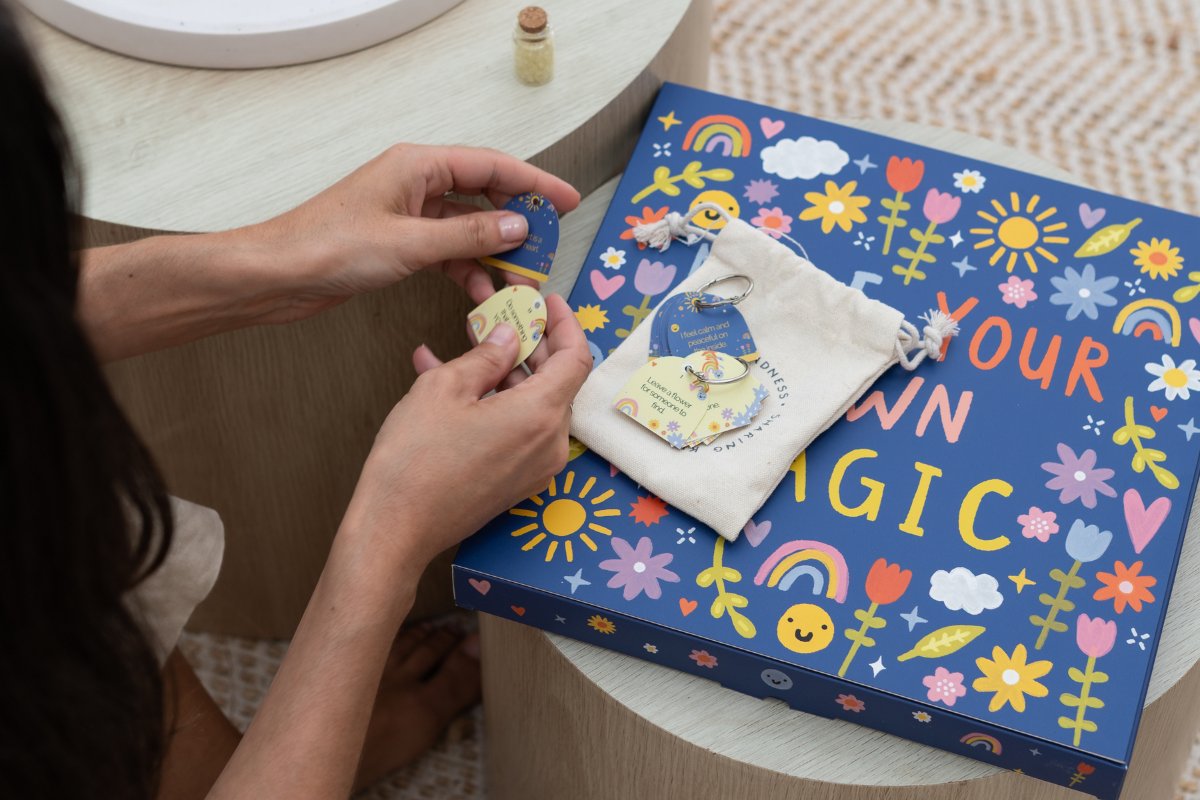
For children aged three to five starting nursery or reception, the priority is something small, soft and easy to attach to a bag or coat. A pocket-sized comfort object, a keyring with a familiar texture or a small photo card in a plastic sleeve all work because they can be touched discreetly at drop-off. The Box of Confidence affirmation cards suit this age group when an adult reads one aloud at breakfast. You can see the Box of Confidence affirmation cards if you want to look before you buy.

For children aged six to nine who are changing schools or moving up a year, the gift needs to feel more grown-up. A small notebook for writing down one worry and one thing to look forward to, a smooth stone to keep in a blazer pocket or a discreet fidget that lives in a pencil case all give the child a private anchor without drawing attention. Children in this age group often reject anything that looks babyish in front of peers, so avoid character-themed items unless you know the child still loves them.
For children with specific sensory needs, match the texture to the child rather than the trend. A child who seeks movement may prefer a stretchy band or a putty-style fidget; a child who avoids mess may prefer a smooth metal or stone object.
A common mistake is buying something too precious. If a child is worried about losing their comfort object, the object becomes another source of stress. Pick something replaceable and easy to keep track of, and label it with a name sticker if it is going into a school bag.
Best for: children aged three to nine who struggle at drop-off or with a change of classroom. Skip if: your child is older and would find illustrated cards or character items too young, or if the school has a no-toys policy that would make the item a source of conflict rather than comfort.
Match the gift to the child's age and needs rather than the occasion.
Printable Affirmation Cards - Box of Confidence →
| Child's age or need | Gift options | Why it works |
|---|---|---|
| Three to five, starting nursery or reception | Pocket-sized comfort object, textured keyring, small photo card | Can be touched discreetly at drop-off |
| Six to nine, changing schools or moving up | Notebook, smooth stone, discreet fidget for pencil case | Private anchor without drawing attention |
| Sensory seekers | Stretchy band or putty-style fidget | Provides movement outlet |
| Children who avoid mess | Smooth metal or stone object | Matches texture preference |
| Any age | Replaceable, labelled item | Avoids stress of losing something precious |
Calming Gifts for Kids: What Actually Helps
Calming gifts work best when they engage the senses and give a child something to do with their hands. Fidget toys, stress balls, textured objects and breathing prompts all fall into this group, and the common thread is that they redirect nervous energy rather than asking a child to suppress it.
Sensory tools are not a cure for anxiety. Generally, they give a child an outlet for nervous energy in a classroom where running around is not an option.
The Positive Mindset Game takes a different route. It uses story prompts and gratitude questions across three levels. A reader looking for a play-based option can explore the Positive Mindset Game.

Check with the teacher before you buy anything that makes sound.
Gifts for Teens with Anxiety: Age-Appropriate Support
Teenagers need gifts that respect their dignity. Anything that reads as babyish will be rejected on principle, no matter how helpful it might be, so the winning options are small, understated and easy to keep private.
The Kindness Crystals pass-it-on stone set suits this age group well. Three raw stones come in a velvet drawstring bag with cards explaining what to do next, giving a teenager something to hold and a reason to pass one on to a friend. It is a gift about connection rather than a gift about being anxious, which is exactly the framing a fourteen-year-old can accept. You can look at the Kindness Crystals stone set for the full details.

Older children also respond better to choice than to surprise. Let them pick from two or three options and you sidestep the eye-roll entirely.
Best for: teens who would rather not discuss their feelings directly. Skip if: your teenager is openly sceptical and would prefer a journal or a playlist.
Back-to-School Anxiety Support: Gifts for the First Weeks
Back-to-school anxiety support matters most in the first fortnight, when routines are still forming and everything feels unfamiliar. Matching a transition gift to a child’s particular worry can also mean pairing it with bedtime routines for anxiety, so the reassurance carries through from the school day into the night.
For a child starting reception or nursery, the transition is about separation and routine.
For a child moving up a year or changing schools, the worry is often about the unknown: a new teacher, a new building, new classmates. You can download the Power of YET poster and print it the same day.
For a child returning after the summer holidays, the transition is often about reconnecting with friends and re-establishing sleep and morning routines. A gift that supports routine, such as a bedtime story book about school, a morning checklist or a small reward chart, can be more useful than a toy.
Classroom practicality matters as much as the gift itself. Schools often restrict toys that make noise, light up or contain small parts.
Printable Affirmation Cards - Box of Confidence →
The NHS advice on anxiety in children is worth reading if your child's worry is affecting sleep or eating, because those signs deserve a conversation with your GP rather than a gift.
Best for: children facing a specific transition, whether that is starting reception, moving up a year, changing schools or returning after the holidays. Skip if: the school has a strict no-toys policy and the item would be confiscated, or if the child is already anxious about losing possessions.
How to Introduce a School Transition Gift
Introducing the gift well matters more than the gift itself. Hand it over at a calm moment, explain what it is for in one sentence, and then let the child lead. A rushed handover in the car park on the first morning defeats the purpose.
Try this three-step approach:
- Pick a quiet moment the day before term starts, not the morning of.
- Explain it simply: "This is for when school feels like a lot. You can keep it in your bag."
- Use it together once, so the child sees how it works before they need it alone.
If you want to go deeper on staying calm yourself while you do this, our guide to modelling emotional intelligence for parents covers how children pick up on your own regulation far more than your words.
Build Confidence Before the First Bell
Confidence before the first bell comes from rehearsal, not reassurance. Children who have practised the routine, visited the school gate and talked through what happens next cope better than children who have simply been told not to worry. Gifts help when they are part of that preparation.
A daily calendar, a visual prompt on the fridge and a small object in the bag all do the same job: they make the unknown feel familiar before the child meets it. Add a bedtime routine that includes one calm conversation about the next day and you have covered most of what a child needs.
Gifts are not enough on their own. If your child's anxiety is stopping them attending school, or lasting well beyond the first few weeks, speak to the school and your GP (School Anxiety and Refusal). A gift is a tool, not a treatment.
The first term is a test of patience for everyone in the house. If you want something concrete to hand your child on the Sunday before school starts, our Box of Confidence affirmation cards and Positive Mindset Game are both built for exactly this moment, with 40 hand-drawn cards and 120 question cards designed to turn big feelings into conversations you can actually have.
Frequently Asked Questions
What is a good gift for an anxious child starting a new school?
A good school transition gift is small, practical and gives the child something to focus on. Affirmation cards, a gratitude rock or a pass-it-on stone set all work because they are portable and come with a simple action. The Box of Confidence affirmation cards suit children aged 4 to 12 and include 40 hand-drawn cards. Pair the gift with a short conversation about what the first day will look like, and let the child choose where to keep it in their bag.
How can a gift help a child with separation anxiety at school?
A gift for a child with separation anxiety works best when it is a physical link between home and school. A small stone, a card or a keyring the child can touch at drop-off gives them a routine to manage the goodbye. Keep the item in their school bag or pocket and agree on when they will hold it, such as at the classroom door or after lunch. The ritual matters more than the object itself, so practise it at home before term starts.
What are some calming gifts for kids with school anxiety?
Calming gifts for kids include items that offer touch or a gentle prompt. A gratitude rock gives children a prompt to pause and name something good, while printable posters such as the Power of YET poster give a visual reminder at home. Sensory tools like fidgets or stress balls can help too, but check with the school first because some classrooms restrict them. Choose one item rather than a bundle so the child is not overwhelmed.
How do I choose an age-appropriate gift for a child with anxiety?
Match the gift to the child's developmental stage rather than their age alone. Children aged 4 to 7 usually respond to simple, tactile items and short prompts, while children aged 8 to 12 can handle affirmation cards and conversation games. For teens with anxiety, avoid anything that feels babyish and offer a low-key item such as a crystal set or a journal. Ask the child what they would use, and keep the gift small so it does not add pressure.
