


Last Updated: November 4, 2026
Quick Summary
Personalised affirmation gifts give a child a named, steady object to hold onto during the first school year, with short first-person phrases they can own and say themselves. Choose simple "I can" statements for ages 4 to 7, and attach the habit to an ordinary moment such as the walk to the school gate.
- In England and Wales, most children start Reception in the September after they turn four.
- Keep affirmations short, first-person and believable, and avoid long abstract phrases for a five-year-old.
- The Box of Confidence holds 40 hand-drawn affirmation cards and includes four characters children can relate to.
- Check which version of the child's name to use, as a gift with the wrong one can feel off.
- Three or four times a week is plenty for a card habit, so skip the pressure to do it daily.
Table of Contents
- Why Personalised Affirmation Gifts Matter for a Child's First School Year
- Positive Affirmations for Kids Starting School: What to Look For
- First Day of School Affirmations: Messages That Settle Nerves
- Affirmation Cards for Children: A Daily Confidence Habit
- Personalised Affirmation Book for Children: Choosing a Keepsake
- Personalisation, Safety and Classroom Suitability
- Choosing a Gift for the Whole First School Year
- Building a Calmer School Routine with Sharing Kindness
- Frequently Asked Questions
Why Personalised Affirmation Gifts Matter for a Child's First School Year
Starting school is one of the biggest transitions in a young child's life. A personalised affirmation gift can give a child something steady to hold onto through that change. A small, named object can help turn a wobbly morning into a manageable one.
The first school year brings new faces, new rules and a lot of small failures: lost jumpers, missed instructions, friendships that need negotiating. A gift that repeats a simple message like "I can try again" gives a child language for those moments before they happen.
That is the case for choosing a gift with meaning over another plastic toy. It also explains why so many parents and grandparents now search for personalised affirmation gifts rather than generic back-to-school presents.
Positive Affirmations for Kids Starting School: What to Look For
The best affirmations for a school starter are short, first-person and believable. Look for short "I am" statements a young child could say without feeling silly.
Watch out: long, abstract affirmations ("I am the architect of my own destiny") mean nothing to a five-year-old and get abandoned fast. Keep it concrete and spoken in their own voice.
Three things separate a useful set from a pretty one:
- First person phrasing. "I can do hard things" works; "You are capable" does not, because the child needs to own the words.
- Age-appropriate language. Ages 4 to 7 need simple vocabulary and friendly illustrations, not motivational poster slogans.
- Open-ended prompts. A card that starts a conversation ("Tell me about a time you were brave") gets used again; a card that only preaches gets ignored.
If you want a deeper look at choosing well, our guide to positive affirmation cards for children walks through what to look for in more detail.
First Day of School Affirmations: Messages That Settle Nerves
In England and Wales, most children start Reception in the September after they turn four (School admissions: School starting age). That first morning usually involves a named peg, a tray with their name on it, a parent at the gate and a classroom that smells of new carpet and glue sticks. The affirmations that help most are the ones that speak to those specific moments rather than to school in general.
Good ones to try before the gate opens:
Box of Confidence - Affirmation Cards →
- "I can hang my bag on my peg."
- "I can ask a grown-up if I need the toilet."
- "I can say hello to one new person."
- "It is okay to feel wobbly. I can still walk in."
- "I can try again if I get something wrong."
Affirmations can feel more natural when they are part of the ordinary school routine, said on a Tuesday in week three as well as on day one. Try saying them while you walk to the school gate, or while your child puts on their shoes, so the words attach to a habit rather than to a performance.
It helps to be honest about what a gift can and cannot do. A personalised affirmation card or book will not remove separation anxiety, and it should not be presented as a fix. Affirmations can work well alongside the ordinary things that help a child settle: a consistent drop-off, a named item they can hold, a short goodbye and a teacher who knows their name. If your child is very anxious, speak to the class teacher or the school's pastoral lead before relying on a gift.
Watch out: avoid turning affirmations into a test. If a child refuses to repeat a phrase, do not push. Leave the card where they can see it and let them come to it. A phrase they choose themselves on a calm day carries more weight than one they are made to recite at the gate.

Affirmation Cards for Children: A Daily Confidence Habit
Affirmation cards for children work best as a small daily habit, not a big ceremonial moment. One card at breakfast, read aloud together, does more over a term than a whole deck read once.
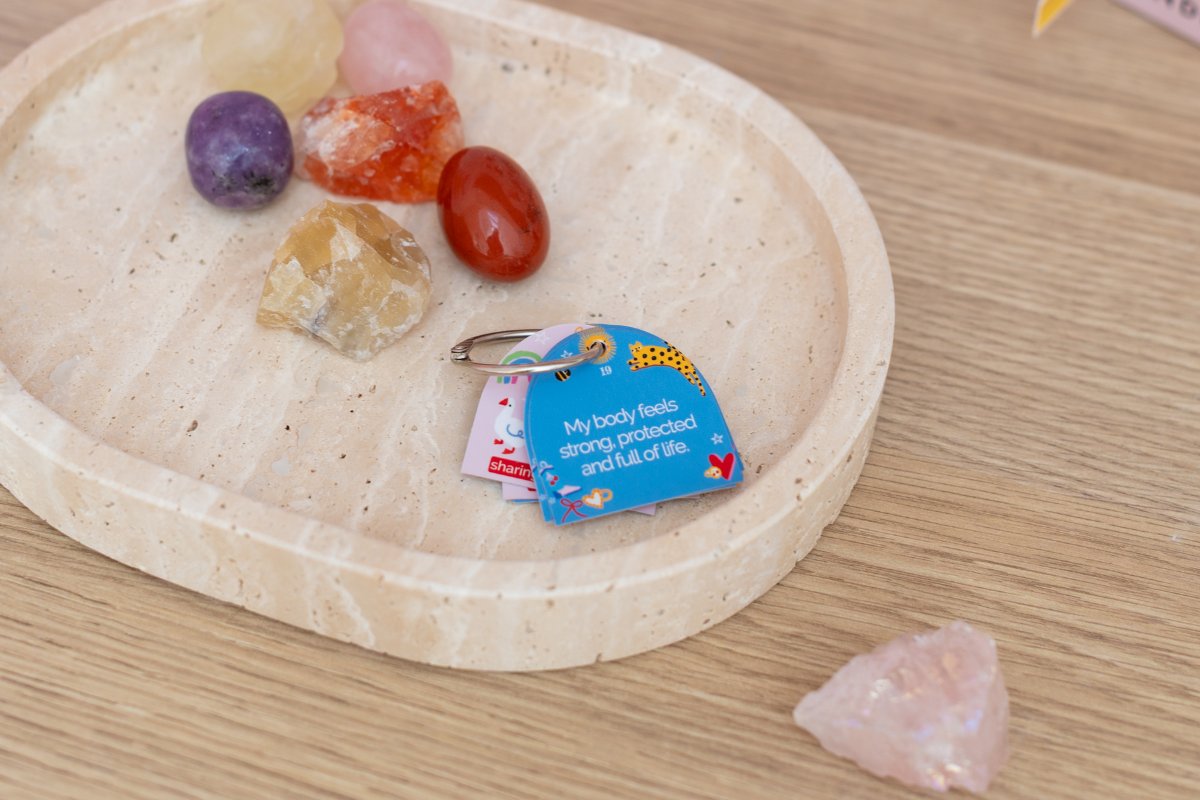
Our Box of Confidence holds 40 hand-drawn affirmation cards with simple words and illustrations, and includes four characters children can relate to. It is designed to help start conversations about feelings.


In practice, the habit sticks when you attach it to something that already happens: the morning toast, the walk to the gate, the moment shoes come off after school. Skip the pressure to do it every single day. Three or four times a week is plenty.
Personalised Affirmation Book for Children: Choosing a Keepsake
A personalised affirmation book for children is a keepsake first and a teaching tool second. It should carry the child's name, feel sturdy enough to survive a school bag, and read like something they will still want at eight or nine.
When you are choosing one, ask:
- Is the name personalisation printed clearly and spelled correctly?
- Are the affirmations age-appropriate for the child receiving it?
- Does it invite writing, drawing or a photo, or is it read-only?
- Will it sit on a desk and get picked up, or stay in a drawer?
If you are planning a keepsake display, our wooden card holder is made to sit alongside our affirmation cards and the Positive Mindset Game, so the cards stay out where they get used.

Personalisation, Safety and Classroom Suitability
Personalisation is where gift orders can go wrong, so check the details carefully. Before you order, decide which version of the child's name to use. A child called Florence may be Flo at home and Florence on the register, and a gift that uses the wrong one can feel off from the first morning.
A few other ordering details worth checking:
Box of Confidence - Affirmation Cards →
For safety and classroom use, keep three things in mind:
- Small parts. Check the age guidance on any card set or game and follow it, especially if there is a younger sibling in the house.
- Durability. School bags are brutal.
- Classroom suitability. Many Reception and Year 1 teachers welcome calm, screen-free resources, but schools differ on what children are allowed to bring in. A printable set can be a practical choice because you can print a copy for home and a copy for the classroom. Our printable affirmation cards are the digital version of the Box of Confidence, which makes them easy to share with a teacher or send in a bag.
If a child is anxious about the transition, keep the gift pressure-free. Leave the cards somewhere visible and let them come to it.

Choosing a Gift for the Whole First School Year
The strongest gift covers the whole year, not just the first morning. That means thinking in phases: settling in during term one, friendship and resilience in the middle terms, and a confidence boost before the next step.
| Gift option | Price | Best for | When to give it |
|---|---|---|---|
| Box of Confidence affirmation cards | $42.95 | Ages 4 to 12, daily habit | Before term one |
| Printable affirmation cards | $12.95 | Classroom or travel use | Start of any term |
| Growth Mindset Poster | $5.95 | Bedroom or study area | Term two onward |
| Power of YET Poster | $5.95 | Children who give up easily | Mid-year |
| Gratitude Poster | $2.95 | Building a thankfulness habit | Any point in the year |
If you are buying as a grandparent or family friend, browse the kindness and affirmation card range to see what is available before you decide.
Building a Calmer School Routine with Sharing Kindness
A calmer school routine is built from small, repeatable moments rather than one big morning overhaul.
Our aim at Sharing Kindness is to raise kinder humans and create a kinder tomorrow, and we have inspired over one million acts of kindness. The Box of Confidence is our tool for that work with children, and the Positive Mindset Game is a family game that builds confidence and connection through stories.
Get started with Sharing Kindness and give a child a first school year that feels a little steadier from day one.
Frequently Asked Questions
What are good affirmation gifts for children starting school?
Look for something that fits the child's age, interests and reading level, and that can be used again and again. Affirmation cards for children work well because they are portable and easy to pick up on a busy morning. A printable set is a lower-cost option if you want to try affirmations before buying a physical gift. Personalised items such as a named card set or a keepsake book add a sense of ownership, which helps a nervous child feel that the gift is theirs.
What positive affirmations can I write for a child's first day of school?
Keep the wording short and believable for the child's age. Simple lines such as 'I can do my best', 'It is okay to ask for help' and 'I am learning and growing' work well for a first school year. Avoid promises about outcomes you cannot control, such as 'I will make lots of friends today'. First day of school affirmations should name feelings and small actions, so the child can use them in the moment rather than treat them as a test to pass.
Are personalised affirmation books suitable for young children?
They can be, provided the book is age-appropriate and the personalisation is simple. For a child in their first school year, look for clear text, sturdy pages and illustrations that carry the meaning. A personalised affirmation book for children also works as a keepsake, because the name makes it specific to that child and that milestone.
How can children use affirmations during the school year without pressure?
Use them as an invitation rather than a task. A card can sit on the breakfast table, go in the school bag or be pinned near the desk, and the child chooses whether to read it. Try one affirmation at a time and let the child pick it, so the habit does not feel like homework. If a card is ignored for a week, leave it out without comment. The aim is a calm routine, not perfect use, and adults modelling the same habit makes it far more likely to stick.
