


Last Updated: 10 November 2026
Quick Summary
The best affirmation cards for neurodivergent teens are short, neuro-affirming statements that acknowledge difficulty and offer a next step, matched to your teen's sensory profile and specific struggles. Look for matte finishes, rounded corners, clear large text and one idea per card, and test the concept with a printable set before buying a physical deck.
- Affirmation cards make a positive thought physical, repeatable and entirely under the teen's control.
- Executive function cards should focus on process, such as doing the first two minutes and stopping if needed.
- Rejection sensitivity cards acknowledge the feeling without letting one reaction become the whole story.
- Anxiety cards should slow the body first, for example by breathing out slowly and dropping the shoulders.
- Read each card aloud in your teen's voice and skip any wording they would roll their eyes at.
Table of Contents
- Why Affirmation Cards Can Work for Neurodivergent Teens
- Neuro-Affirming Language vs Toxic Positivity
- ADHD Affirmations That Address Executive Function and Rejection Sensitivity
- Positive Affirmations for Anxious Teens: Calming the Nervous System
- Positive Affirmations for Teenagers: Building Self-Compassion and Realistic Thinking
- Printable Affirmation Cards for Neurodivergent Teens: Digital Downloads vs Physical Decks
- Sensory-Friendly Design: What Makes a Deck Work for Autistic Teens
- How to Choose Affirmation Cards for Your Teen
- Frequently Asked Questions
Why Affirmation Cards Can Work for Neurodivergent Teens
Finding the best affirmation cards for neurodivergent teens starts with understanding why they work at all. Affirmation cards are small cards printed with short, positive statements that a teenager can read, hold, or display as a daily reminder.
A card that says something kind is easier to pick up than a conversation that feels like a lecture. That matters even more for teens whose brains process praise, criticism, and social cues differently.
Neurodiversity and Self-Esteem: What Parents Need to Know
Self-esteem builds differently for neurodivergent teens. Many spend years receiving corrections: sit still, speak up, slow down, try harder. Over time, that feedback can crowd out the kinder voice inside. Affirmation cards work as a counterweight because they offer a neutral, low-pressure reminder that does not come with a disappointed face attached. For parents whose teen rejects praise outright, our guide to confidence gifts for teens who dislike praise covers how to build self-worth without triggering that resistance.
Neuro-Affirming Language vs Toxic Positivity
The difference between a helpful affirmation and a harmful one comes down to honesty. Neuro-affirming language acknowledges how a teen actually feels and offers a next step. Toxic positivity skips the feeling entirely and demands a smile instead. A card that says "I am allowed to take up space" affirms. A card that says "good vibes only" dismisses.
What to Look For and What to Avoid
| Look for | Avoid |
|---|---|
| Statements that allow difficulty ("I can try again tomorrow") | Statements that deny feelings ("I am always happy") |
| Language about effort and process | Language about being perfect or fixed |
| Words the teen would use themselves | Adult-sounding slogans |
| Permission to rest and ask for help | Pressure to "just be positive" |
A useful test: read the card out loud in your teen's voice. If it sounds like something they would roll their eyes at, it will not land.
ADHD Affirmations That Address Executive Function and Rejection Sensitivity
ADHD affirmations work best when they target the two areas that cause the most daily friction: executive function and rejection sensitivity. Executive function covers the mental skills used for planning, starting tasks, switching focus, and holding information in mind long enough to act on it. Rejection sensitivity is the intense emotional sting that follows real or imagined criticism, and it can turn a small correction into a spiral that lasts for hours.
A card that says "starting badly still counts as starting" addresses the first area by lowering the barrier to beginning. A card that says "one person's reaction is not the whole story" addresses the second by putting a single moment back into perspective. Both are short enough to absorb in the moment when the teen is already overwhelmed.
Executive function affirmations for ADHD
Executive function struggles often show up as paralysis before a task, losing track halfway through, or abandoning a project when it stops feeling novel. Affirmations that help here tend to focus on process rather than outcome. Examples include:
- "I can do the first two minutes and stop if I need to."
- "Finishing badly is better than not finishing at all."
- "I can use a timer and then decide what comes next."
- "My brain works differently, and I can build systems that fit it."
These statements work because they give the teen a concrete next action rather than a vague instruction to try harder. They also model self-compassion when the task still does not go to plan.
Rejection sensitivity affirmations for ADHD
Rejection sensitivity can make a neutral comment feel like a verdict on the teen's whole character. Affirmations that help here acknowledge the feeling without letting it become the whole story. Examples include:
- "One person's reaction is not the whole story."
- "I can feel upset and still be okay."
- "I am allowed to ask for clarification before I decide what someone meant."
- "My worth does not change based on one conversation."
Keep the wording short and concrete. Teens with ADHD often skim past long sentences, so a phrase they can absorb in two seconds does more work than a paragraph.
Watch out: a card that demands a big emotional shift ("I will not care what anyone thinks") can feel unrealistic and get rejected. Cards that allow the feeling to exist while offering a small next step tend to stay in use longer.
Positive Affirmations for Anxious Teens: Calming the Nervous System
Positive affirmations for anxious teens need to slow the body before they try to convince the mind. Physical reminders of these grounding techniques can extend beyond paper cards to the garments found at The Fine Girl Boutique, which integrate these calming prompts directly into the fabric of daily life.
For more on the evidence side, our article on whether affirmation cards really help anxious teens looks at what parents should realistically expect.
Positive Affirmations for Teenagers: Building Self-Compassion and Realistic Thinking
Self-compassion and realistic thinking are the two skills that make positive affirmations for teenagers stick. Self-compassion means speaking to yourself the way you would speak to a friend. Realistic thinking means replacing "I always mess this up" with "I messed up this one thing, and I can fix part of it." Cards that model that swap teach a skill rather than offering a mood boost.
This is where cognitive reframing quietly happens. A teen who reads "I can be kind to myself while I learn" is practising a new thought pattern, one card at a time.
Printable Affirmation Cards for Neurodivergent Teens: Digital Downloads vs Physical Decks
Printable affirmation cards for neurodivergent teens suit some families better than a physical deck, and the reverse is just as true. Digital downloads let you print at home, replace lost cards, and try the concept before spending more.
| Format | Best for | Watch out for |
|---|---|---|
| Printable PDF download | Trying the idea, tight budgets, replacing lost cards | Printing and laminating takes effort |
| Physical card deck | Gifting, daily handling, teens who like objects | Higher upfront cost |
Our printable affirmation cards are a low-cost way to test whether your teen engages before committing to a full deck. If they take to it, the physical Box of Confidence deck is the version built to last.


Sensory-Friendly Design: What Makes a Deck Work for Autistic Teens
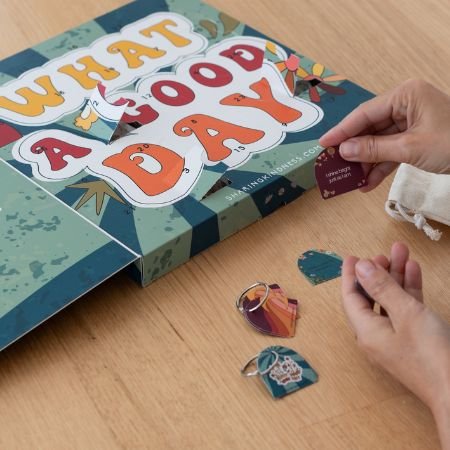
Sensory-friendly design decides whether a deck gets used or abandoned in a drawer. For autistic teens, texture, size, and visual busyness all matter. Dense illustrations can overwhelm. One idea per card helps.
Watch out: a deck with heavy visual clutter and long sentences will often be quietly rejected by a sensory-sensitive teen, no matter how good the words are.
How to Choose Affirmation Cards for Your Teen
Choosing well comes down to matching the deck to your teen's sensory profile, their specific struggles, and the way they actually use objects day to day. Most guides stop at "pick positive words," but for a neurodivergent teen the physical and linguistic details decide whether a deck gets used or left in a drawer.
Sensory-friendly design checks
Texture, size, and visual busyness matter as much as the wording. A deck that feels unpleasant to hold will not be picked up, no matter how good the statements are. Look for:
- Matte finish rather than high gloss, which can feel slippery or squeaky.
- Rounded corners rather than sharp ones.
- A card size that fits comfortably in one hand or a pocket.
- Clear, large text with good contrast. Dyslexia-friendly fonts (such as sans-serif typefaces with distinct letter shapes) reduce reading effort.
- One idea per card. Dense illustrations or multiple sentences per card increase cognitive load.
A common pattern is that autistic teens and teens with sensory processing differences reject decks with heavy visual clutter before they even read the words. If your teen is sensitive to texture, a printable version on matte card stock can be a lower-risk way to test the concept.
Language and tone checks
Read the wording and confirm it is affirming rather than dismissive. Neuro-affirming language acknowledges difficulty and offers a next step, while toxic positivity skips the feeling and demands a smile. A useful test is to read the card out loud in your teen's voice. If it sounds like something they would roll their eyes at, it will not land. Statements about effort and process ("I can try again tomorrow") tend to work better than statements about fixed traits ("I am always confident").
Matching statements to actual struggles
A deck full of generic positivity is less useful than one that targets the friction points your teen actually experiences. If executive function is the main struggle, look for cards about starting, finishing, and asking for help. If rejection sensitivity is the main struggle, look for cards about perspective and self-worth after criticism. If anxiety is the main struggle, look for cards that slow the body first (breathing, dropping shoulders) before offering a broader statement about being brave.
Let your teen choose where possible
Autonomy matters more for neurodivergent teens than for many of their peers, and a deck chosen for them can feel like another correction. Where possible, show two or three options and let them pick the wording and the format. If they reject the idea entirely, a printable version left on a desk without comment can be a lower-pressure entry point than a formal gift.
Start small and test
Start with a printable version if you are unsure. Digital downloads let you print at home and try the concept before committing to a physical deck.
If you are ready to browse, you can explore the full affirmation cards range and choose the deck that fits your teen's sensory profile and specific struggles.
The hardest part is not buying the cards. It is starting the habit and keeping it gentle.
Frequently Asked Questions
What are some effective affirmations for teenagers?
Effective affirmations for teenagers are specific, believable, and focused on effort rather than outcome. Instead of 'I am perfect,' try 'I can handle this setback' or 'I'm learning and that counts.' For neurodivergent teens, affirmations that acknowledge difficulty while reinforcing capability work best, such as 'My brain works differently and that's okay' or 'I can ask for help when I need it.' Avoid sweeping statements that feel unrealistic, as teens are quick to dismiss anything that sounds hollow.
What are some positive affirmations that can help people with ADHD?
ADHD affirmations should address common struggles like task initiation, emotional regulation, and rejection sensitivity. Examples include 'I can start small and build momentum,' 'My worth isn't measured by my productivity,' and 'I'm allowed to take breaks.' These phrases work because they counter the shame that often builds up when executive function challenges make daily tasks harder. Pairing affirmations with visual reminders, like keeping a card on a desk or mirror, helps reinforce the message during moments of frustration.
Are printable affirmation cards useful for neurodivergent teens?
Printable affirmation cards offer flexibility that physical decks can't match. You can print them at home, and they are a lower-cost way to try affirmation practice before committing to a full deck. A printable set paired with a [Wooden Card Holder](https://sharingkindness.com/products/wooden-card-holder) gives the cards a place to sit on a desk or table.
What should affirmation cards for autistic teenagers include?
Affirmation cards for autistic teens should use clear, literal language without idioms or metaphors that might confuse. They should affirm neurodivergent identity rather than frame autism as something to overcome. Look for cards that acknowledge sensory needs, special interests, and the value of boundaries. Cards that encourage self-advocacy, like 'I can say no without explaining myself,' are particularly useful.
