


Last Updated: October 30, 2026
Quick Summary
Positive mindset games help children with social emotional learning because they let children practise emotional skills in the moment, not in theory. A simple card game or craft project feels safe, so kids talk, and one game can touch all five core social emotional learning skills at once. Short, low-stakes tries beat a single lecture.
- Social emotional learning covers five core skills, and a game can touch all five at once.
- Keep games to about ten minutes, since ten good minutes beats forty forced ones.
- Answer a card prompt yourself first, because modelling beats instructing every time.
- Seal kindness rocks with a clear acrylic sealant and let it cure fully before hiding.
- Start with one game and one routine rather than collecting lots of resources.
Table of Contents
- Why positive mindset games work for social emotional learning
- Social emotional learning activities for kids that start with a card, not a lecture
- Empathy games for kids: practising perspective-taking out loud
- Positive mindset activities for children you can run in ten minutes
- The kindness rocks activity for kids: a craft that teaches generosity
- Common mistakes when introducing mindset games at home
- Choosing your first positive mindset game for your family
- Frequently Asked Questions
Why positive mindset games work for social emotional learning
Positive mindset games work because they let children practise emotional skills in the moment, not in theory. Simple card games and craft projects can turn big feelings into everyday conversation. The format matters: a game feels safe, so kids talk.
Social emotional learning covers five core skills: self-awareness, self-management, social awareness, relationship skills and responsible decision-making (What Is SEL?). A game touches all five at once. Your child names a feeling, waits their turn, listens to someone else and chooses how to respond. That is a lot of learning disguised as fun.
The pace helps too. A lecture gives a child one shot to get it right, while a game gives them dozens of small, low-stakes tries.
If you want to see how this looks in practice at home, our guide to positive mindset games for mums to play at home walks through the games we reach for most often.

Social emotional learning activities for kids that start with a card, not a lecture
Social emotional learning activities for kids work best when the child leads. A card prompt does that. It asks a question, your child answers, and you listen without correcting.
Here is a simple format to try:
- Pick one prompt. "What is something kind someone did for you this week?"
- Answer it yourself first. Modelling beats instructing every time.
- Let silence sit. Give your child ten seconds before you fill the gap.
- Follow their lead. Ask "tell me more" instead of "that's right".
Matching the activity to your child's age
Age changes the format, not the goal. Younger children need movement and pictures. Older children need to feel it was their idea.
| Age | Best format | What to expect | Watch for |
|---|---|---|---|
| 4-6 | Picture cards, short prompts | One-word or one-sentence answers | Keep it under five minutes |
| 7-9 | Turn-taking card games | Longer stories, some silliness | Let them change the rules |
| 10-12 | Open questions, journalling | Pushback and testing limits | Do not correct their answers |
| Teens | Side-by-side chat, not eye contact | Reluctance, then honesty | Skip the lecture |
Empathy games for kids: practising perspective-taking out loud
Empathy games for kids train one skill: seeing a situation from another person's view. The trick is to say it out loud, because children learn perspective-taking by hearing it modelled.
Try this one at dinner. Describe a small everyday problem, like a friend being left out at lunch. Then ask: "What might that friend be feeling? What might they want someone to do?"
You will get answers that surprise you. Some children jump straight to fixing. Others notice the feeling first. Both are useful, and both are worth naming.
For more structured activities, our collection of perspective taking activities for kids gives you ready-made prompts for different ages.
Positive mindset activities for children you can run in ten minutes
Positive mindset activities for children do not need a whole afternoon. Ten minutes, done often, can be more effective than a big session once a month.
The gratitude round. Each person names one good thing from their day. No repeats, no judging.
The reframe game. Someone says a gloomy thought, like "I'm bad at maths". The group offers a kinder, truer version: "Maths is hard for me right now."
The kindness story. Tell a short story about someone who helped another person, then ask what the helper might have felt.
Each takes minutes. Each builds the same muscle: noticing your own thinking and choosing a different angle.
The kindness rocks activity for kids: a craft that teaches generosity
The kindness rocks activity for kids is simple: paint a stone, write a kind message on it, then leave it somewhere for a stranger to find. It teaches generosity because the child never sees the reward, and it teaches perspective-taking because the child has to imagine who might pick it up and how they might feel.
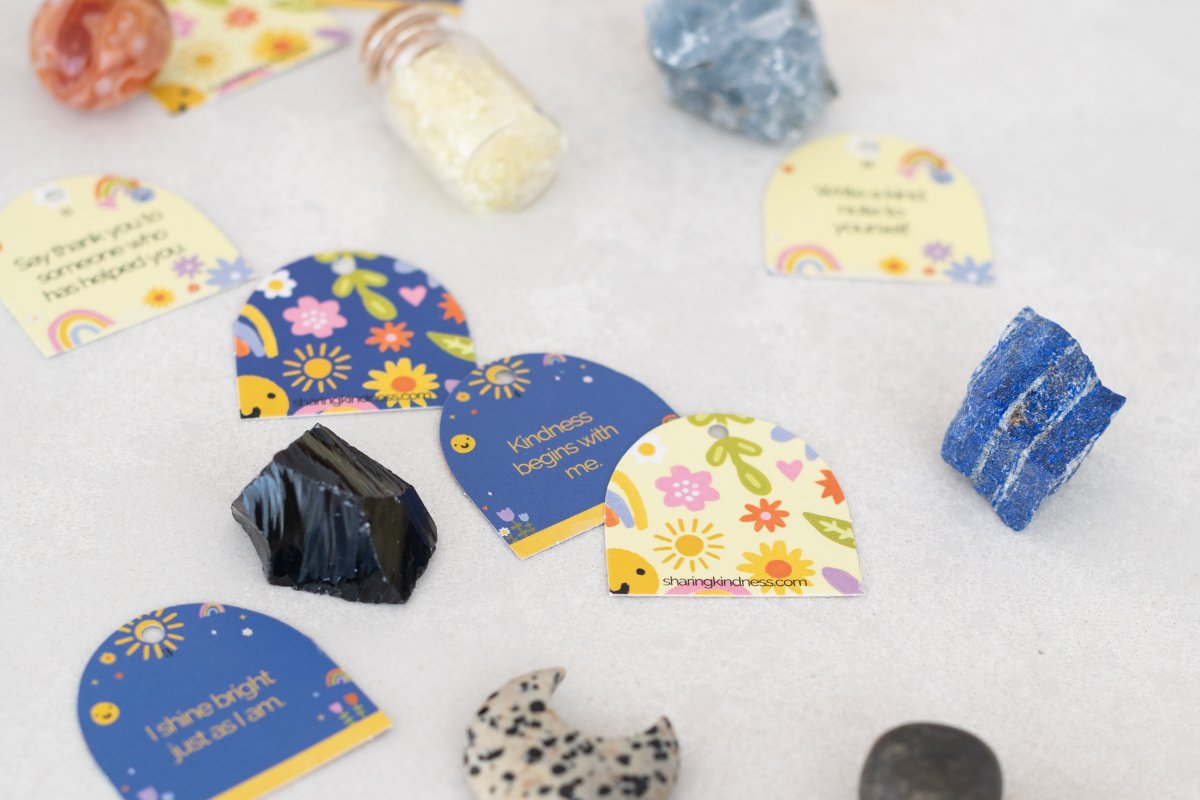
Step by step from bare stone to hidden stone
- Choose the right rock. Smooth river rocks from a garden centre work best. Avoid porous stones such as sandstone, which soak up paint unevenly, and avoid collecting from beaches or riverbanks where removal can disturb habitats.
- Wash and dry fully. Paint will not bond to dust or grit. A quick rinse and a full air-dry on a towel is enough.
- Paint a base coat. Acrylic paint or acrylic paint pens give solid coverage. Let it dry completely before adding detail.
- Add the message. Short phrases work best: "You are enough", "Keep going", "Be kind today". Younger children can use dotting tools or stickers; older children can use fine-line brushes for lettering.
- Seal the finished rock. A clear acrylic sealant or waterproof varnish protects the design from rain and handling. Follow the cure time on the tin before hiding.
- Hide thoughtfully. Choose a sheltered spot, keep stones off fragile plant life, and check local rules before leaving anything in a public space.
Choosing materials that survive the weather and the environment
Weather is the part most guides skip. A rock left in the rain with poster paint will fade within days, and that disappoints the child who made it. Use acrylic paint or acrylic paint pens rather than watercolour or poster paint, seal the finished rock with a clear coat sealant or waterproof finish, and let the sealant cure fully before hiding the stone. Ensuring your creations withstand the elements mirrors the resilience required of sensory fidget toys that endure the rigours of constant handling.
The environmental side matters just as much. Many craft acrylics and spray sealants contain plastics that can shed into soil and waterways over time. Where you can, choose water-based acrylics and a sealant labelled as water-based or eco-friendly, and avoid glitter, which is difficult to remove once it reaches a drain or hedgerow.
Where to hide stones without causing harm
Good hiding spots are visible enough to be found but sheltered enough to survive a week of British weather. Try low walls, bench edges, gateposts and the base of a tree in a park. Avoid national parks, Sites of Special Scientific Interest, nature reserves and waterways, where leaving painted objects can breach local bylaws or harm wildlife. Check with your local council before hiding stones in public spaces, and keep them off fragile plant life and gravestones.
Tracking a stone's journey
A stone that disappears is not a failure. It has been found. Some families add a small hashtag or a handwritten note on the back inviting the finder to share where the stone turned up, which turns a single craft into a longer conversation about how far a small kindness can travel. Keep any tracking note free of personal details such as a child's full name or school.
If your child loves this craft, our complete guide to kindness stones covers more designs and hiding ideas.
Common mistakes when introducing mindset games at home
The biggest mistake is treating the game as a test. If your child senses they are being assessed, they will shut down. Games work because they feel low-stakes.
Other mistakes we see often:
- Correcting answers. "That's not a positive thought" ends the conversation.
- Skipping your own turn. Children learn most from hearing you be honest.
- Going too long. Ten good minutes beats forty forced ones.
- Forcing it when they are tired. Try again tomorrow.
Watch out: if a game becomes a chore, stop. A drawer full of unused cards teaches nobody anything.
For parents who want to go deeper on the values behind this, our guide on how to teach kindness to kids covers the bigger picture.
Choosing your first positive mindset game for your family
Start with one game and one routine. That is the whole strategy. Families who stick with this tend to play the same game regularly rather than collecting lots of resources.
Ask yourself three questions:
- Will my child actually engage with this? Choose a format that fits their personality.
- Can we do it in ten minutes? If not, it will not happen on a school night.
- Does it start conversations? That is the whole point.
Our Positive Mindset Game is built around this idea. It has 120 question cards across three levels, plus 12 action cards hidden among them.

Best for: families with children aged roughly 4 to 12 who want a shared routine. Skip if: you are looking for a solo activity your child does alone.
Building emotional skills in children is slow work, and it rarely looks like progress on any given day. What helps is having a simple tool within reach when the moment comes, rather than a perfect plan you never start.
Sharing Kindness makes games and cards designed to start those conversations, including the Positive Mindset Game with its three levels of question cards, the Box of Confidence affirmation cards for kids aged 4 to 12, and the printable Power of YET poster for the wall. Get started with Sharing Kindness and give your family a simple way to talk about feelings, gratitude and confidence together.
Frequently Asked Questions
What are positive mindset games for children?
They are structured games, usually card-based, that prompt children to talk about gratitude, feelings and challenges in a low-pressure way. A good example is a three-level card game with question prompts and action cards, where children answer prompts about what went well, what felt hard, or what they would do differently. The game format removes the interrogation feel of direct questions, so children aged 4-12 are more willing to share. The aim is repetition: small, regular conversations that gradually shift how a child frames setbacks.
How can parents adapt mindset games for different ages?
For four to six year olds, keep prompts concrete and answer them yourself first so they hear a model. For seven to nine year olds, let them pick the card and give them thinking time without filling the silence. For ten to twelve year olds, skip the warm-up and go straight to the deeper prompts, and let them ask you the questions too. A game with levelled question cards makes this easier because you can move up or down a level in the same session without changing the format.
Can kindness activities help children build resilience?
They can help, particularly when the activity involves naming a feeling and then doing something about it. The kindness rocks activity for kids works this way: a child paints a message, decides where to leave it, and then handles the uncertainty of not knowing who finds it. That small experience of doing something for someone else, without needing credit, gives children a sense of agency. Pair it with a conversation afterwards about how it felt, and you have turned a craft into a resilience exercise.
How long should a social and emotional learning activity last?
Ten to fifteen minutes is usually enough for children aged four to twelve, and shorter is better than longer when everyone is tired. A few question cards at dinner, or one round of an empathy game before bed, does more than a forty-minute session that ends in tears. Consistency beats duration: three short sessions across a week will land better than one big one. Stop while it is still going well, so the child associates the activity with feeling good rather than with being tested.
