


Last Updated: 30 October 2026
Quick Summary
Positive mindset games for mother and child work best as short, playful routines rather than lectures. Simple activities such as a bedtime gratitude stone or a quick Three Good Things round give children a reason to talk and share, and each takes only a few minutes.
- Keep bedtime gratitude games to five minutes, passing a stone and naming one good thing each.
- The Three Good Things round takes about three minutes and suits children from around four upwards.
- The Weather Report takes ninety seconds and works well for talking in the car.
- Choose affirmations that are true and specific, such as "I can try again tomorrow", rather than grand claims.
- Mothers can pick an affirmation card for themselves and say it aloud alongside their child.
Table of Contents
- Why Positive Mindset Games Work Better Than Lectures
- Gratitude Games for Children to Try at Bedtime
- Positive Thinking Activities for Kids on Busy Days
- Kindness Activities for Kids That Turn Inward
- Positive Affirmations for Children and How to Use Them
- Mothers Learning Alongside Their Children
- Start One Positive Mindset Game This Week
- Frequently Asked Questions
Why Positive Mindset Games Work Better Than Lectures
Positive mindset games for mother and child can work because children often learn through play, not through being told what to think. When a mum sits down with her child and asks a playful question about the best part of their day, the conversation does the teaching. Nobody has to deliver a speech about gratitude.

Lectures tend to slide off children. A game gives them a reason to talk, to laugh, and to share something real about themselves. The Positive Mindset Game is built around sharing stories, feelings and small action cards.
Games also remove the pressure on the adult. You don't need the perfect words. You just need to turn over a card and listen.
Gratitude Games for Children to Try at Bedtime
Bedtime is a natural pause in the day, which makes it a good time for a short gratitude game. Keep it to five minutes so it doesn't become another chore.
Try this simple routine:
- Hold a smooth stone or the Gratitude Moon Rock from our Positive Mindset Game.
- Each person names one thing that felt good today, however small.
- Pass the stone to the next person and repeat.
- Finish with one thing you're looking forward to tomorrow.
Children can surprise parents here. Accept every answer warmly. The habit is the point, not the quality of the answer.
Positive Thinking Activities for Kids on Busy Days
Many positive mindset games assume a free evening, while school runs, tea, bath and bedtime leave gaps of five minutes or less. The three below need no equipment beyond what is already in the kitchen or the car, and each one has a fixed end point so nobody has to negotiate about when it stops. You can also find all of these in one go in the Mindset Must Haves bundle.
The Three Good Things round. At tea, each person names three things that went well that day. The rule is that at least one has to be small: the bus arriving on time, a good sandwich, a funny text from a friend. Naming three rather than one forces the child past the first obvious answer and gets them searching their day for evidence. It takes about three minutes and works with children from around four upwards.
The Weather Report. Ask your child to describe their mood as weather: sunny, cloudy, stormy, foggy, with a light drizzle. Then ask one follow-up question: what would change the forecast? Children who struggle to answer "how do you feel?" often answer this one easily because it gives them an image to work with. It takes ninety seconds and is useful in the car, where children often talk more freely than they do face to face.
The One Thing I Can Control. When a child is wound up about something outside their control, such as a cancelled trip or a falling-out with a friend, ask them to name one thing about the situation they can control and one thing they cannot. Write both on a sticky note if there is time. The point is not to dismiss the worry but to separate the parts of it that have a next step from the parts that do not. This one takes about two minutes and is worth repeating with the same wording each time so it becomes familiar.
A word on timing: these work best when they are routine rather than rescue attempts. A child who does a routine like the Weather Report every week may come to use it on a hard day without being asked, whereas one who only sees it in a crisis may read it as a sign that something is wrong.
The Printable Growth Mindset Poster and Power of YET Poster from our shop can sit alongside these games. Print one, put it on the fridge, and point to it when a child says "I can't do this."
If you want a ready-made structure for busy days, the Positive Mindset Game includes 120 question cards that can be drawn one at a time, so a session can last five minutes or thirty depending on the day. The 21-day tracker is useful here too: tick the day off even if the game was a single card in the car, because the habit is what carries the benefit, not the length of any one session.
Three short games for busy days, each with a fixed time and what it is for.
| Game | Time | Best for |
|---|---|---|
| The Three Good Things round | About three minutes | Children from around four upwards |
| The Weather Report | Ninety seconds | Talking in the car |
| The One Thing I Can Control | About two minutes | Worries outside a child's control |
Kindness Activities for Kids That Turn Inward
Kindness is often framed as something children do for others. It can help to teach them to be kind to themselves as well.
The 30-Day Kindness Challenge and Kindness Bucket List Kit can be used for this. Include at least one item each week that is about looking after themselves, such as resting, drawing, or saying something nice about their own effort. Ask them afterwards how that felt compared with the acts aimed at other people.
Positive Affirmations for Children and How to Use Them
Affirmations only help when a child can believe them. A sentence like "I am the best at everything" can feel false to a child who is struggling, and they will notice the gap between the words and their experience. Choose statements that are true and specific, such as "I can try again tomorrow" or "I'm learning, and that takes time."
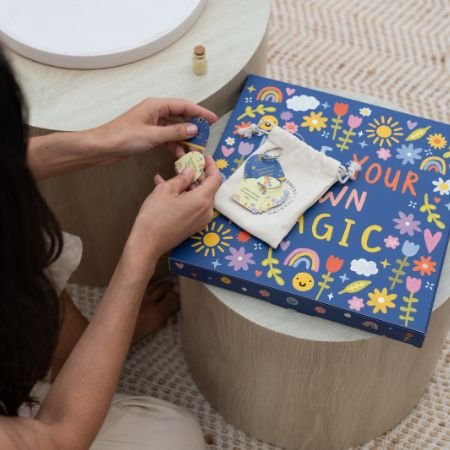
The Box of Confidence affirmation cards include 40 hand-drawn cards with four characters children can relate to. Read one card aloud at breakfast or in the car, then ask what the child thinks it means. You can print ready-to-use affirmation cards to start straight away. Keep the conversation loose.
There is a second use for these cards that matters just as much, and it is the one most kindness lists leave out. Mothers can use them too, for themselves. Picking a card for yourself, reading it in the car before school pick-up, and letting it be true for the length of the drive is a small act of self-kindness that costs nothing and takes a minute.
A practical way to build this in: after your child has chosen a card, choose one yourself and say it out loud. "I can ask for help when I need it" or "I do enough" are both believable for most parents on most days. Hearing you say it shows your child that affirmations are not just for children.
If you want more on the adult side of this, our guide on non-spiritual self care for busy mums covers the same principle in more depth.
Mothers Learning Alongside Their Children
Mums can play these games while still working things out for themselves. You don't need to have mastered gratitude or self-compassion before sharing it with your child. Admitting you're learning too is one of the most useful things you can model.
When you play, you can answer your own question first. Say something honest, like "Today I felt impatient, and I'm still working on that." Real moments tend to matter more to children than polished ones. For more ideas tailored to adults, read our guide on non-spiritual self care for busy mums, and see our article on positive mindset games for mums to play at home.
Start One Positive Mindset Game This Week
Pick one activity from this article and try it three times this week. Choose the bedtime gratitude stone, the busy-day check-in, or a single affirmation card. Consistency matters more than variety.
If you'd like a ready-made option, the Positive Mindset Game includes 120 question cards, a Gratitude Moon Rock, a 21-day tracker and journalling prompts, all designed to get families talking. It's a gentle way to start building a more positive mindset together.
Frequently Asked Questions
What games can help children develop a positive mindset?
Simple card and conversation games work well. Ask your child to share one good thing from their day, one worry, and one thing they are proud of. Games built around stories of gratitude, fears and feelings encourage children to notice the good alongside the hard. The Positive Mindset Game from Sharing Kindness uses 120 question prompt cards across three levels, with action cards hidden among them, so each round stays fresh. Play for a short time after dinner or at bedtime and keep it light.
How can I teach my child positive thinking through play?
Make positive thinking a habit rather than a lesson. Play a question game where each answer is a small observation, such as something that made you laugh or a kind thing someone did. Praise effort over outcome when you notice it, and name your own positive thoughts out loud during everyday moments. Children copy what they see far more readily than what they are told, so your own tone during the game matters as much as the cards themselves.
What are some easy gratitude games for mums and children?
Try a gratitude rock passed between you at bedtime. Each person holds the rock and names one thing they are grateful for, then passes it on. Another option is a three-good-things circle at breakfast, where each person names three things from yesterday. The Gratitude Rock from Sharing Kindness can be used in both of these routines. Keep the rules short so younger children can join in without frustration.
What kindness activities can a mother and child do together?
Choose one small kind act each day and do it side by side, such as leaving a note for a neighbour, drawing a card for a grandparent, or picking up litter on a walk. The 30-Day Kindness Challenge and the Kindness Bucket List Kit are printable options that give you a ready list of ideas. Talk briefly afterwards about how the act felt for each of you. Showing kindness towards yourself counts too, so include one act of self-kindness in the week.
