


Table of Contents
- Why Self-Kindness Daily Matters (Especially Before Christmas)
- Daily Self-Compassion Exercises You Can Do in Five Minutes
- How to Stop Negative Self-Talk Without Pretending Everything Is Fine
- Self-Compassion Phrases to Borrow When You Cannot Find the Words
- Self-Care for Busy Mums: Fitting Kindness Into a Full Day
- Build a Daily Self-Kindness Routine That Survives December
- Common Mistakes That Stop Self-Kindness Daily From Sticking
- Conclusion: Kindness Starts Within
- Frequently Asked Questions
Last Updated: October 9, 2026
Why Self-Kindness Daily Matters (Especially Before Christmas)
Learning how to practise self-kindness daily is one of the most grounding habits you can build, and it matters most in the weeks before Christmas. At Sharing Kindness, we believe kindness starts within and when you learn to be kind to yourself you will build a strong foundation for sharing kindness with others. The festive season turns that pressure up. School concerts, gift lists, family politics, and the endless mental load all land at once.
Kindness starts within. When you learn to be kind to yourself, you build a strong foundation for sharing kindness with others. That is not a soft idea. It is practical. You cannot pour from an empty cup, and December empties cups fast.
So here is the plan: seven simple steps, most of them under five minutes.
Daily Self-Compassion Exercises You Can Do in Five Minutes
Daily self-compassion exercises work best when they are small enough to survive a chaotic morning. Forget the hour-long ritual. Two minutes done daily beats an hour done once.
The Hand on Heart Check-In
This takes sixty seconds. Place your hand on your chest. Take three slow breaths. Ask yourself one question: what do I need right now?
The answer might be water, a sit-down, or five minutes without being touched. Whatever it is, try to give it to yourself. The physical touch calms your nervous system, which is why this works when thinking alone does not.
The Gratitude Rock Reset
A gratitude rock is a small stone you carry in your pocket or keep by your bed. When you see it or touch it, you name one thing you are grateful for.
That is the whole practice. Our Gratitude Rock exists for exactly this reason. It gives your hands something to hold while your mind slows down. Kids love it too, which means you can practise side by side.

How to Stop Negative Self-Talk Without Pretending Everything Is Fine
You stop negative self-talk by noticing it, naming it, and answering it the way you would answer a friend. You do not stop it by forcing positivity. That approach backfires, because your brain knows you are faking it.
Most of us speak to ourselves in a tone we would never use on anyone else. The goal is not to silence that voice. The goal is to soften it.
Name It, Then Reframe It
Try this three-part pattern:
Crystal Calendar | Self-Love →
- Notice: "I'm having the thought that I'm failing at Christmas."
- Normalise: "Lots of mums feel this in December."
- Reframe: "I'm doing a lot with very little sleep."
Notice the difference. You are not arguing with the thought. You are adding context to it. That small shift takes the sting out.
Self-Compassion Phrases to Borrow When You Cannot Find the Words
Self-compassion phrases give your brain a shortcut when it goes blank. Borrow these until they feel like yours.
- "This is hard, and I'm doing my best."
- "I don't have to earn rest."
- "One thing at a time is enough."
- "I can be kind to myself and still want to do better."
- "I'm allowed to be a work in progress."
Say them out loud if you can. Out loud hits differently than in your head.
Phrases for Kids to Hear You Say Out Loud
Your kids learn self-talk by copying yours. Let them hear you say:
- "I made a mistake. I'll try again."
- "I'm tired, so I'm going to rest."
- "That was tricky, and I kept going."
This is where our Box of Confidence earns its place. It is a set of positive affirmation cards for kids aged 4 to 12, and it gives the whole family shared words for hard feelings.
Self-Care for Busy Mums: Fitting Kindness Into a Full Day
Self-care for busy mums is not a spa day. It is a series of small decisions that protect your energy across an ordinary Tuesday.
The trick is to attach kindness to something you already do. No extra calendar space required.
Moment You Already Have |
Tiny Kindness Habit |
Time Needed |
|---|---|---|
Kettle boiling |
Three slow breaths, hand on heart |
1 minute |
Sitting in the car |
Name one thing that went right |
2 minutes |
Shower |
Say one kind phrase out loud |
1 minute |
Bedtime |
Hold your gratitude rock, name one good thing |
2 minutes |
None of these need an app, a planner, or a spare hour. They need you to remember them, which is why the physical reminder matters so much.
Build a Daily Self-Kindness Routine That Survives December
A routine survives December when it is tied to an object or a moment, not to willpower. Willpower is the first thing to go when the calendar fills up.
Here is how we would build it:
- Pick one anchor moment you never miss, like the morning kettle.
- Choose one object to cue it, such as a gratitude rock on the worktop.
- Set the bar embarrassingly low. One breath counts.
- Track it loosely. A tick on the fridge is plenty.
- Restart without drama when you miss a day.
That last point matters most. Missing a day is not failure. Quitting because you missed a day is the only real risk.
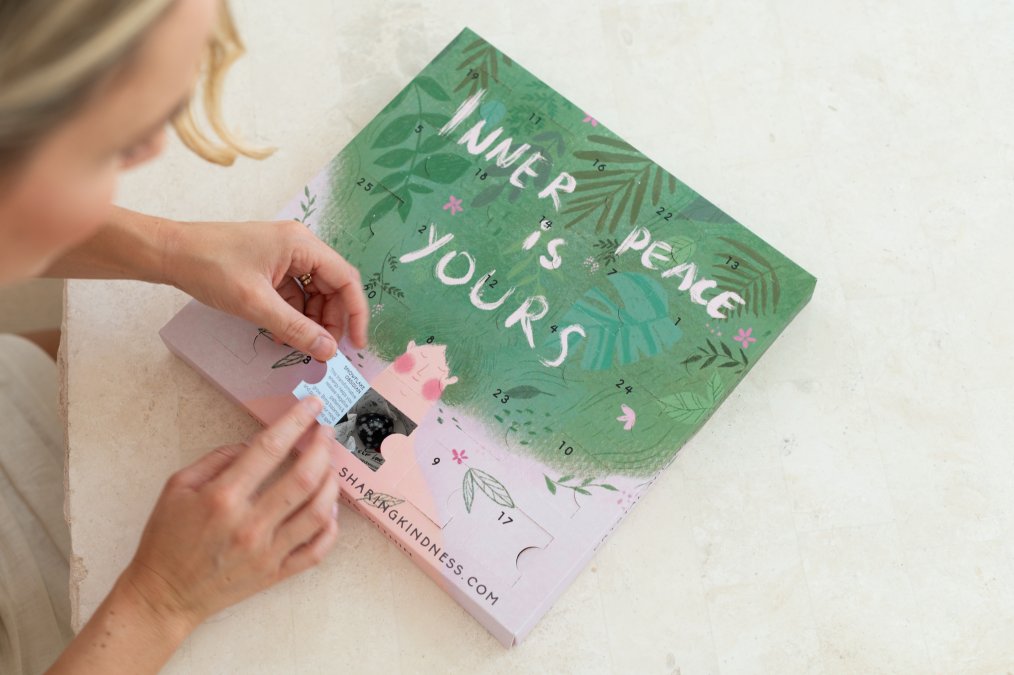
Our Crystal Advent Calendar follows the same logic across December. You open one panel a day, revealing a crystal and a mini affirmation card. It gives you a built-in daily moment of self-care for 25 days, which is exactly the kind of structure that carries you to Christmas.
Crystal Calendar | Self-Love →

Common Mistakes That Stop Self-Kindness Daily From Sticking
The biggest mistake is treating self-kindness as a reward you earn. It is not a bonus for good behaviour. It is maintenance.
Other traps we see often:
- Going too big too fast. A 45-minute routine collapses by day three.
- Confusing self-kindness with self-indulgence. Kindness asks what you need. Indulgence asks what feels good right now.
- Doing it only when things go wrong. Daily practice works because it is boring and regular.
- Hiding it from your kids. Let them see it. That is half the value.
- Expecting to feel different straight away. Most people notice the shift after a few weeks, not a few days.
A common mistake is waiting until you have your own emotions fully sorted before modelling anything for your children. You do not need to be nailing it. You need to be practising in front of them.
Conclusion: Kindness Starts Within
December will be busy no matter what you do. The question is whether you go through it running on empty or with a small, steady reserve of kindness for yourself.
That reserve is what lets you show up for everyone else without resentment. It is also what your kids will remember, far more than the gifts.
If you want a daily structure that makes it easy, our Crystal Advent Calendar gives you 25 crystals and 25 affirmation cards, one for each day of December. For younger kids, the Kindness Advent Calendar offers a daily act of kindness the whole family can do together.
Get started with Sharing Kindness and give your family a December built on kindness, starting with your own.
Frequently Asked Questions
What does it mean to practise self-kindness?
Practising self-kindness means treating yourself the way you would treat a friend who is having a hard day: with patience, honest encouragement and no lecture. It is not about lowering your standards or letting everything slide. It is about dropping the harsh running commentary when you make a mistake, rest when you are tired, and speak to yourself in a tone you would be happy for your children to copy. Small, repeated moments of this build the habit faster than one big gesture.
What is the difference between self-kindness and self-compassion?
The two overlap closely. Self-kindness is the action: the words you choose, the rest you take, the way you respond after a mistake. Self-compassion is the broader stance behind those actions, which also includes recognising that struggle is part of being human rather than a personal failing. In practise, you can build self-compassion through daily self-compassion exercises such as a hand on the heart check-in or a short breathing pause before you react to yourself.
How can busy mums practise self-kindness during the Christmas period?
Lower the bar rather than adding another task. Pick one anchor moment you already have, such as the first sip of your morning coffee or the drive home from school pickup, and use it for a single self-compassion phrase. Keep a gratitude rock in your pocket or on the worktop so your hand finds it without effort. If you want something structured, a crystal advent calendar gives you one small self-care moment a day for 25 days, which suits the weeks when your schedule is already full.
Can practising self-kindness help me be kinder to others?
It usually does, because the way you speak to yourself sets the tone for how you speak to everyone else. Parents who are constantly critical of themselves tend to run shorter fuses with their children, not because they care less but because the inner criticism uses up the patience they need. When you learn how to stop negative self-talk and replace it with something fairer, you have more room to respond calmly when your child spills the glitter everywhere ten minutes before school.