


Last Updated: October 26, 2026
Quick Summary
To learn how to introduce crystals to children safely, agree three house rules first: crystals stay out of mouths and noses, they are not food or medicine, and they live in one spot. Start with large tumbled stones of 4cm or bigger, and keep all loose crystals away from children under three.
- Tumbled stones are the safest starting point at every age because they have no sharp edges.
- Anything small enough to fit inside a toilet roll tube is a choking risk for children under three.
- If a child swallows a crystal, call the Poisons Information Centre on 13 11 26 straight away.
- Clean crystals with a soft cloth and plain water, but keep soft stones like selenite dry.
- Start a first set with three or four tumbled stones, a small pouch and an explanation card.
Table of Contents
- Why Crystals Appeal to Children and How to Set Ground Rules
- Crystal Safety for Children: Age, Size and Choking Risks
- What to Do If a Child Swallows a Crystal
- Crystals for Kids Activities That Build Calm and Confidence
- How to Clean Crystals Safely Before Children Handle Them
- Talking About Crystals Without the Woo: What to Say to a Sceptical Child
- Choosing Your First Crystal Set for a Child
- Frequently Asked Questions
Why Crystals Appeal to Children and How to Set Ground Rules
Children are drawn to crystals for the same reason adults are: they are small, smooth, colourful objects that feel good in the hand. At Sharing Kindness, we hear from parents every week who want to know how to introduce crystals to children safely, and the answer starts with a simple idea. A crystal is a physical anchor for a feeling. That is all a child needs it to be.
What Children Actually Get From a Crystal
A child does not care about the geological name of a stone. What they get is a small object they can hold when big feelings arrive.
A common mistake is over-explaining. Children aged 4 to 12 respond to concrete actions, not theory. Hand a child a smooth stone and say "this is your brave stone, you can squeeze it when you feel nervous" and you have given them a tool. That is the whole method.
Crystals can help children:
- Name a feeling out loud
- Practise calming their body
- Take a pause before reacting
- Feel a sense of ownership over their own emotions
The stone is not doing the work. The pause is.
The Three House Rules to Agree Before the First Stone
Set the rules before the crystals come out, not after something goes wrong. We suggest three, agreed out loud with your child:
- Crystals stay out of mouths and noses. No exceptions, no matter the age.
- Crystals are not food and not medicine. They are for holding, looking at and playing with.
- Crystals live in one spot. A small dish or pouch on a shelf keeps them safe and stops them ending up in the washing machine.
Write them down together if your child is old enough. A rule a child helps make is a rule a child follows.
Crystal Safety for Children: Age, Size and Choking Risks
Crystal safety for children comes down to three things: age, size and surface. A stone that is safe for a ten-year-old is not safe for a toddler, and a rough stone is not safe for anyone.
The main risk is choking. Small, smooth stones are exactly the shape that young children put in their mouths. The choking hazard guidance from the ACCC is clear that anything small enough to fit inside a toilet roll tube is a risk for children under three.
Beyond choking, watch for:
- Sharp edges. Raw stones can have points and rough faces.
- Chips and flakes. A damaged stone can shed small pieces.
- Dust. Some softer stones crumble. Wipe them before handing them over.
- Dyes and coatings. Cheap polished stones are sometimes dyed. Skip anything with colour that rubs off.
Which Stones Suit Which Age Group
| Age group | Safe options | What to avoid |
|---|---|---|
| Under 3 | None. Use a large smooth stone in a sealed jar instead | All loose crystals |
| 3 to 5 | Large tumbled stones, 4cm or bigger | Anything small enough to swallow |
| 6 to 8 | Tumbled stones, polished points | Raw stones with sharp edges |
| 9 to 12 | Tumbled and raw stones with supervision | Very small chips and beads |
Tumbled stones are the safest starting point at every age. They have no sharp edges and they fit comfortably in a small hand.
Crystal Calendar | My Trinkets →
What to Do If a Child Swallows a Crystal
If a child swallows a crystal, stay calm, check their breathing and call your local poisons information line straight away. In Australia, that is the Poisons Information Centre on 13 11 26, available 24 hours a day. Do not wait for symptoms.
What to tell the operator:
- What the stone was and roughly how big
- What time it happened
- Your child's age and weight
- Whether your child is breathing normally, coughing or in pain
Do not try to make your child vomit (the NHS). Do not give them food or water to "push it down". Follow the advice you are given.
Watch out: a stone can pass through without harm, but a stone that blocks the airway is an emergency. If your child is struggling to breathe, call 000 immediately.
After the call, put the remaining crystals out of reach until you have had a chance to review how the situation happened. Most incidents come from a stone left within reach of a younger sibling, not from the child who owns it.
Crystals for Kids Activities That Build Calm and Confidence
Crystals for kids activities work best when they are short, repeated and led by the child. Ten minutes a day beats an hour once a month.
Here are four we recommend, all simple enough to start today:
- The feelings stone. Put three stones in a bowl. Assign one to each feeling: calm, worried, excited. Ask your child to pick the one that matches how they feel right now.
- The brave stone pocket. Your child chooses one stone to carry for the week. At bedtime, they tell you one moment they felt brave.
- The kindness stone. Your child hides a stone somewhere for someone else to find, with a small note. This one is a favourite in our house.
- The breathing stone. Your child holds the stone and breathes in for four counts, out for four counts, three times.
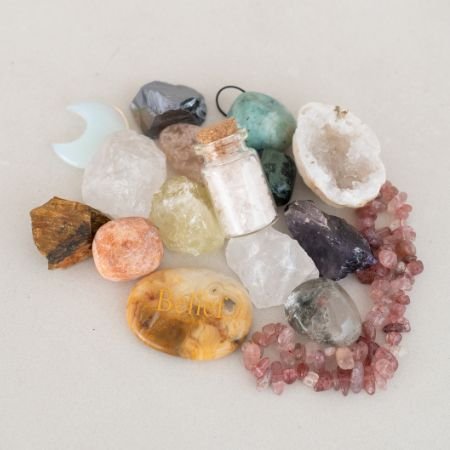
If you want more gentle ideas to pair with crystal play, our guide to gentle parenting activities for 4-12 years is a good next read. For the confidence side, these practical steps to build confidence in kids work well alongside a daily stone ritual.
How to Clean Crystals Safely Before Children Handle Them
Clean crystals before they go to a child, and clean them again after they have been in a pocket, a school bag or a sandpit. How to clean crystals safely depends on the stone, but the basics are the same.
- Wipe first. A soft cloth removes dust and fingerprints.
- Use plain water for hard stones. Quartz, amethyst and rose quartz handle a quick rinse.
- Keep soft stones dry. Selenite and halite dissolve or flake in water. Wipe only.
- Skip the harsh stuff. No bleach, no vinegar, no essential oils on anything a child will hold.
- Dry fully. Pat dry and leave to air before storing.
Watch out: some polished stones are glued to a base or coated in resin. Water can loosen the glue. If the stone feels sticky or looks coated, wipe it only.
Talking About Crystals Without the Woo: What to Say to a Sceptical Child
Not every child buys in, and that is fine. A sceptical child is usually a child who wants to know how something works. Give them a straight answer.
Try this: "Some people believe crystals have special energy. I don't know if that's true. What I do know is that holding something calm and taking a slow breath helps your body settle down. That part is true for everyone."
Crystal Calendar | My Trinkets →
That answer does three things. It is honest, it respects your child's intelligence, and it keeps the tool useful.
A common mistake is overselling. If you promise a crystal will fix a feeling, your child will notice when it does not. Keep the claim small and the tool stays trusted.
For older children who roll their eyes, drop the word "crystal" and call it a "focus stone" or a "pocket stone". Same object, less baggage.
Choosing Your First Crystal Set for a Child
Choosing a first crystal set is easier when you buy for the child in front of you, not the child in the brochure. If you are unsure whether a crystal set suits a beginner, read are crystal gift sets good for beginners before you commit. Start with three or four tumbled stones, a small pouch and a card explaining what each stone is for.
If you are buying for a child, our crystal gift set for kids is a gentle way to start the conversation without a big outlay.
Want to see the full range first? You can browse all crystal gift sets for kids and friends.
One honest note: our Crystal Advent Calendars are designed for adults and teenagers, not young children. Each panel holds a stone of around 30mm, and the listing states clearly that the calendar is not suitable for kids who tend to put small objects in their mouths. For a child under eight, start with a dedicated kids set instead.
Introducing crystals to children safely takes a bit of thought, a few clear rules and a stone that fits in a small hand. That is the whole job. At Sharing Kindness, we make tools that help families have these conversations, from our Box of Confidence affirmation cards for kids aged 4 to 12 to our Positive Mindset Game that gets everyone talking around the table. Both are built to turn a feeling into a conversation, which is exactly what a first crystal does. Get started with Sharing Kindness and give your child a small, simple way to name what they feel.
Frequently Asked Questions
Are crystals safe for children to handle?
Polished, tumbled crystals are safe for most children over three to handle under supervision, provided they are larger than a choking hazard and free of sharp edges or loose fragments. The main risks are small stones going into mouths, rough or splintered specimens scratching skin, and dust from soft stones being breathed in. Check each stone for cracks before handing it over, keep very small pieces away from under-fives, and wash your hands and theirs after handling. Supervision matters more than the stone itself.
What crystals should children avoid?
Skip raw specimens with jagged points, soft stones that crumble or shed dust such as malachite or selenite, and any dyed or artificially coated stones where colour can flake or transfer to hands. Avoid very small tumbled chips around children who still mouth objects, and anything with a natural sharp edge like raw quartz points. For younger children, stick to smooth tumbled stones around 30mm or larger, which are easier to hold and harder to swallow.
How should crystals be cleaned before children handle them?
Wipe polished stones with a damp cloth and a drop of mild soap, rinse, and dry fully with a soft cloth. Avoid soaking softer stones, and never put crystals in a dishwasher. For a deeper clean, a brief dip in cooled boiled water works for hard stones like quartz and amethyst, but keep soft or porous stones dry. Clean new stones before first use and give frequently handled ones a wipe every week or so, especially after outdoor play.
Can children use crystals for mindfulness activities?
Yes, and the stone is really just a focal point. A child can hold a smooth crystal while taking five slow breaths, describe how it feels in their hand, or pair it with an affirmation card from a set like the Box of Confidence. The value comes from the pause and the conversation, not the stone's properties. Keep sessions short, around two to five minutes for younger children, and let them lead rather than turning it into a lesson.
