


Table of Contents
- Emotional Resilience Activities for Kids: What Actually Works
- Emotional Regulation Activities for Kids: Helping Big Feelings Settle
- Coping Skills for Children: Practical Tools for Tricky Moments
- Resilience Worksheets for Kids: Simple Ways to Make It Stick
- Positive Self-Talk for Kids: Turning 'I Can't' into 'I Can't Yet'
- Building Emotional Resilience Through Play and Family Connection
- Conclusion: Start With One Activity This Week
- Frequently Asked Questions
Last Updated: 6 October 2026
Emotional Resilience Activities for Kids: What Actually Works
Emotional resilience is a child's ability to experience big feelings and recover from them without falling apart, and it is built through small, repeated moments rather than one-off lessons. This guide from Sharing Kindness covers the emotional resilience activities for kids that genuinely hold up in everyday family life, from two-minute calming games to a printable poster that shifts how a child talks about failure.
Here is the part most guides get wrong: resilience is not something a child either has or doesn't. It is a set of skills, and skills need practice, repetition and, ideally, a grown-up doing them alongside the child. The activities below are the ones we come back to again and again because they work on ordinary Tuesdays, not just in calm, well-planned moments.
Raising Children Network guide to child development
Emotional Regulation Activities for Kids: Helping Big Feelings Settle
Emotional regulation activities for kids are short, physical or playful routines that help a child notice a feeling and bring their body back to calm. The goal is not to stop the feeling, it is to give the child something to do with it.
A common mistake is introducing these activities mid-meltdown. Teach them when everyone is calm, then use them when things go sideways. Below are two we use constantly.
Name It to Tame It: Feelings Charades and Feelings Jars
Naming a feeling reduces its intensity, which is why "name it to tame it" has become a staple of parenting advice. Feelings charades turns that idea into a game: one person acts out a feeling, everyone else guesses it. It works because children get to try on emotions from a safe distance.
A feelings jar works the same way in quieter form. Fill a jar with slips of paper, each naming a feeling. At dinner, everyone pulls one out and shares a time they felt it. It takes three minutes and it normalises the full range of emotions, not just the comfortable ones.
Calm-Down Kits and Breathing Buddies
A calm-down kit is a small box a child helps assemble, containing things that soothe them: a soft toy, a squishy ball, a picture of a favourite place. The child choosing the contents matters more than what goes in.
Breathing buddies pair a favourite soft toy with slow breathing. The child lies down, places the toy on their tummy and watches it rise and fall. Five slow breaths is usually enough to take the edge off.
Coping Skills for Children: Practical Tools for Tricky Moments
Coping skills for children only stick when they are small enough to remember under pressure. A five-step strategy will be forgotten mid-tantrum. A single word or action will not.
Try these three, taught in calm moments and practised often:
- The hand trace: the child traces each finger slowly while breathing in and out. Five fingers, five breaths.
- The weather report: "What's the weather inside you right now?" gives a child language for a feeling without demanding they explain it.
- The two-choice reset: offer two acceptable options, such as a hug or a glass of water. Choice returns a sense of control.
None of these solve the problem. They create enough space for the child to move through it.
| Tricky Moment | Coping Skill to Try | What It Does |
|---|---|---|
| Meltdown at home | Hand trace breathing | Slows the body, buys time |
| Sibling conflict | Weather report | Names the feeling, no blame |
| Refusal to get ready | Two-choice reset | Returns a sense of control |
| Anxious at bedtime | Calm-down kit | Gives comfort they chose |
Resilience Worksheets for Kids: Simple Ways to Make It Stick
Resilience worksheets for kids work best as a repeatable ritual rather than a one-off task. The value is in the repetition, not the worksheet itself.
A simple weekly page with three prompts is plenty:
- One thing that felt hard this week
- One thing I got through anyway
- One thing I'd tell a friend in the same spot
Keep completed pages in a folder. After a few months, the child has visible proof of their own resilience, which is far more convincing than a parent saying "you're so resilient."
Positive Self-Talk for Kids: Turning 'I Can't' into 'I Can't Yet'
Positive self-talk for kids is the habit of catching a fixed statement and adding one word: yet. "I can't do this" becomes "I can't do this yet." That single word shifts a dead end into a work in progress.
The trick is modelling it out loud. When you catch yourself saying "I'm hopeless at this," correct it in front of your child: "I'm hopeless at this yet." Children copy what they hear far more than what they're told.
Our Power of YET Poster does the same job on a bedroom wall. It is a printable, so you can have it up within minutes, and it gives the family a shared phrase to point at when someone is stuck.
Building Emotional Resilience Through Play and Family Connection
Play is where resilience gets practised without anyone calling it practice. A card game that asks a child to share a fear, a gratitude or a story gives them a low-stakes way to handle real feelings.
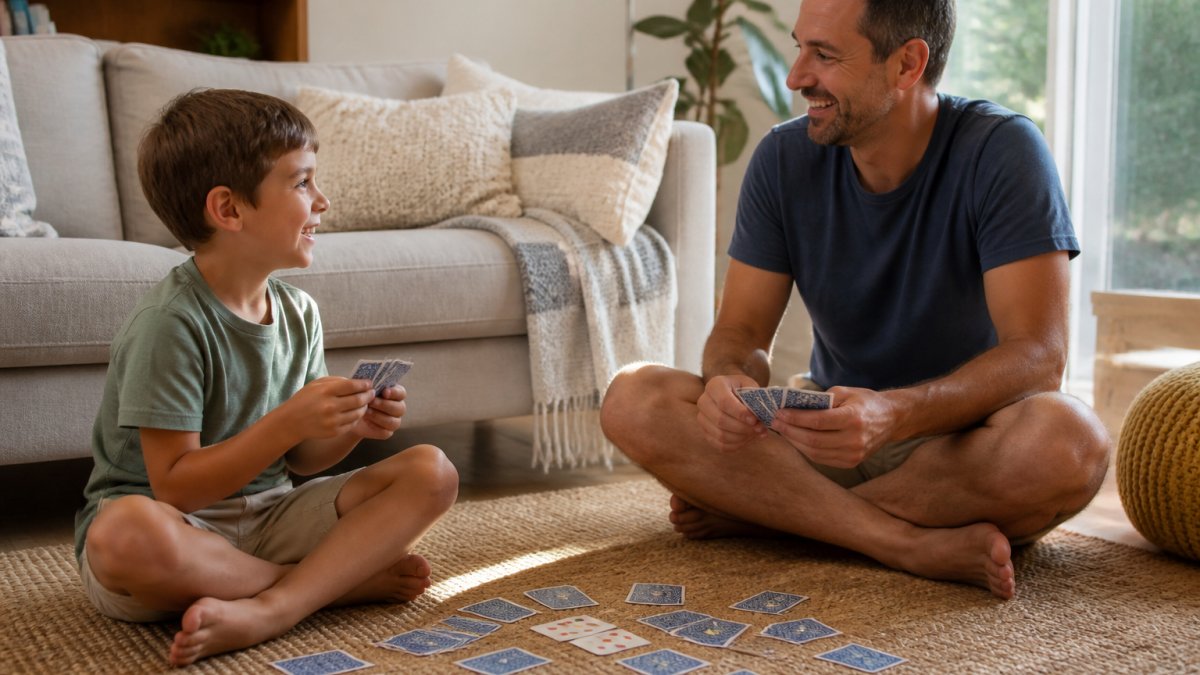
This is why we made the Positive Mindset Game. It has 120 question cards across three levels, plus action cards, a gratitude moon rock, a 21-day tracker and journaling prompts. It asks children to share stories, struggles and feelings, and it asks the grown-ups to do the same. That last part is what makes it work. A child who sees a parent admit something hard learns that honesty is safe.

For kids who respond better to something they can hold and shuffle daily, the Box of Confidence offers 40 hand-drawn affirmation cards built to start real conversations about feelings and self-worth, not just nice words.

Conclusion: Start With One Activity This Week
The hardest part of building emotional resilience in kids is not knowing what to do. It is starting when the week is already full and nobody has slept well.
Pick one thing from this guide. The hand trace at bedtime. A feelings jar on the kitchen worktop. One round of the game after dinner. Then do it again next week, and the week after. Resilience is built in the ordinary repetition, not the perfect lesson.
At Sharing Kindness, we make tools for exactly that kind of ordinary moment: the Positive Mindset Game for family connection, the Box of Confidence for daily self-talk, and printables like our Growth Mindset Poster for the wall where your child will actually see them. Get started with Sharing Kindness and give your family a shared language for the hard days.
![Growth Mindset Poster [PRINTABLE]](https://cdn.shopify.com/s/files/1/0217/4609/0056/files/PosterFrameMockupsforEmailsSKFREEBIEFriday_1.png?v=1695788121)
Frequently Asked Questions
What activities help children build emotional resilience?
Activities that combine naming feelings, practising calm-down strategies, and reflecting on challenges work best. Try feelings charades, a calm-down kit with sensory items, gratitude journaling, and affirmation cards. The Sharing Kindness Positive Mindset Game uses 120 question cards across three levels to prompt conversations about gratitude, fears, and feelings, which builds emotional resilience through regular family connection.
How can I teach my child to cope with big feelings?
Start by naming the feeling together. Children who can label an emotion are better able to manage it. Create a calm-down corner with a breathing buddy, a feelings jar, or sensory toys. Practise coping skills for children when everyone is calm, not mid-meltdown, so the strategies become familiar. Role-play tricky scenarios during play so your child rehearses responses before they need them.
What are resilience worksheets for kids and do they actually help?
Resilience worksheets for kids are simple printable or written prompts that guide a child through reflecting on a challenge, identifying what they learned, and spotting what they could try next time. They help because they turn a vague idea like 'bounce back' into something concrete. A 21-day gratitude tracker, like the one included with the Positive Mindset Game, gives children a daily habit of noticing the good.
How do you explain resilience to a child?
Use the word 'yet'. Instead of 'I can't do this', teach 'I can't do this yet'. Explain that resilience is like a muscle: every time they try something hard and keep going, it gets a little stronger. The Power of YET printable poster from Sharing Kindness reinforces this message visually, so the idea stays front of mind in bedrooms and classrooms.
Can play help children develop emotional resilience?
Yes. Play gives children a safe space to practise frustration, negotiation, losing, and trying again. Board games, card games, and role-play all build emotional resilience because they involve small setbacks within a low-stakes environment. The Sharing Kindness Positive Mindset Game combines play with 120 conversation cards, so children build resilience while connecting with family rather than feeling lectured.
How can children practise bouncing back after a setback?
After a setback, wait until emotions settle, then ask three questions: what happened, what did you try, and what could you try next time? This turns a failure into a problem-solving exercise. Pair it with positive self-talk for kids, such as 'That was hard, and I kept going'. Over time, children internalise this pattern and start doing it without prompting.